Source: Public information of Slovenia,
The Surveying and Mapping Authority of the Republic of Slovenia,
State map in measure 1 : 1.000.000, 1995
www.gu.gov.si
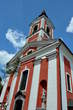
Bled is one of the most unique places in Slovenia, visited every year by many tourists. It is known mainly for its island with a church and a castle on a rocky cliff. The church of St. Martin is located on the edge of the center of Bled, in the direction of Bled Castle. It was built in 1905 on the site of a previous 15th century Gothic church. Even before 1000, the first chapel was erected here. The plans for the construction were made by prof. Friderich von Schmidt, who also authored the Vienna City Hall. Architect Josip pl. Vancaš, however, changed his plans mainly with regard to interior design. In the church of St. Martin you can see the plastics of the conservator Ivan Vurnik from Radovljica, which are mostly made of Karar marble. Academic painter Slavko Pengov painted the church with murals between 1932 and 1937. In the years before Second World War, the greatest Slovenian architect Jože Plečnik designed a garden sign that you can see in front of the church. The 15th-century walls, which are preserved to this day, are reminiscent of the Turkish invasions. Next to the church you can see the building of the parish of Bled.
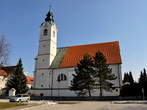
Brezje in Gorenjska is famous as a pilgrimage place of Slovenian Cristians. Brezje is visited across all year, but the main meeting is at the festival of Maria Pomagaj in 24 th of May. Brezje are situated in outstanding beauty of Slovenian land, because they lie in Gorenjska flat country under rich woods of Karavanke, Jelovica and Pokljuka under powerful Triglav. Brezje are first mentioned in 11th century, but at least in 15th century was there modest church of saint Vid, which belonged in parish church Mošnje. In basilica of saint Vid today worship merciful image Mother of God, which was painted by Leopold Layer in the year 1814 and people name it »Marija Pomagaj«. In the year 1907 was crowned by Ljubljana's bishop Anton Bonaventura Jeglič with permission of pope Pij X.
 KRAJI - Slovenia
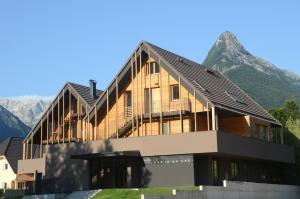 BovecHotel Sanje ob Soči ***/****