Source: Public information of Slovenia,
The Surveying and Mapping Authority of the Republic of Slovenia,
State map in measure 1 : 1.000.000, 1995
www.gu.gov.si
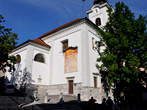
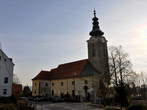
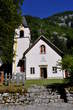
Bled is one of the most unique places in Slovenia, visited every year by many tourists. It is known mainly for its island with a church and a castle on a rocky cliff. The church of St. Martin is located on the edge of the center of Bled, in the direction of Bled Castle. It was built in 1905 on the site of a previous 15th century Gothic church. Even before 1000, the first chapel was erected here. The plans for the construction were made by prof. Friderich von Schmidt, who also authored the Vienna City Hall. Architect Josip pl. Vancaš, however, changed his plans mainly with regard to interior design. In the church of St. Martin you can see the plastics of the conservator Ivan Vurnik from Radovljica, which are mostly made of Karar marble. Academic painter Slavko Pengov painted the church with murals between 1932 and 1937. In the years before Second World War, the greatest Slovenian architect Jože Plečnik designed a garden sign that you can see in front of the church. The 15th-century walls, which are preserved to this day, are reminiscent of the Turkish invasions. Next to the church you can see the building of the parish of Bled.
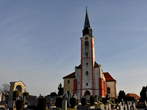
Brezje in Gorenjska is famous as a pilgrimage place of Slovenian Cristians. Brezje is visited across all year, but the main meeting is at the festival of Maria Pomagaj in 24 th of May. Brezje are situated in outstanding beauty of Slovenian land, because they lie in Gorenjska flat country under rich woods of Karavanke, Jelovica and Pokljuka under powerful Triglav. Brezje are first mentioned in 11th century, but at least in 15th century was there modest church of saint Vid, which belonged in parish church Mošnje. In basilica of saint Vid today worship merciful image Mother of God, which was painted by Leopold Layer in the year 1814 and people name it »Marija Pomagaj«. In the year 1907 was crowned by Ljubljana's bishop Anton Bonaventura Jeglič with permission of pope Pij X.
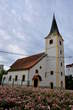
Sticna Abbey is situated among Dolenjska hills. Among the rare working cloisters is the only one, which belongs to Cistercian monks. The Cistercian order originates to the year 1098 to Burgundija in France. It got the name by the place called Citeaux. The founders were three saints, which were the benedictine monks from the monastery in Molesme. The Sticna Abbey is today the important cultural and religious memorial. It was established from the patriarch Peregrin I. At that time it also got lots of property. The monks Cistercians have beside prayers dedicated lots of their time to charity, work and economical activity. From the 13th century they also work on pastoral soul. In the second part of the 15th century had experienced many attacks from Turks and had crisis in the 16th century. The new blossoming was in the 17th century. That lasted till its disbandment in the year 1784. The abbey was again inhabited in the year 1898. It is the oldest in the Slovenian territory. In Sticna Abbey lived well-known Slovenian medical man Simon Asic. Here were also educated Anton Tomaz Linhart and Jakob Petelin Gallus. The complex of the abbey is composed from the Romanic cloistral church – basilica, which was in baroque twice renovated, early Gothic cross – shaped corridor with frescoes and the line of the buildings with the change from the 17th and 18th century. In the first floor are museum and gallery collections from the Slovenian religious museum. Part of the garden in the walls at the southern side comprehends meditative park, which is completely distant from the other areas and ordered like the peaceful, green grass. In the shop you can buy well – known herbs of the Simon Asic and products of other monks.
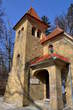
The most beautiful World War I monument is a wooden shrine that rises high above the Tolminka riverbed – the memorial church of the Holy Spirit in Javorca. The church in the walley of Polog was built by Austrian soldiers in 1916, to the design of the Austrian architect Remgius Geyling.
The outside of the church is decorated with stylised coats-of-arms of all the monarchies and lands of Austria-Hungary. The interior is classic art nouveau, adorned with colourful decorations. The idea of a memorial church is communicated through engraved oak plaques bearing the names of all the Austro-Hungarian soldiers who lost their lives on the hills of Vodil vrh, Mrzli vrh, Rdeči rob and Sleme.
Owing to its predominantly wooden construction, prone to rapid decay, and severe weather conditions, the church has undergone several renovations, the most recent one being in 2005. The church in Javorca was proclaimed a historical monument with the 1990 Order declaring natural and historical monuments and natural attractions in the Municipality of Tolmin.
Kojsko is an interesting village, which belongs to the Municipality of Brda. The place was until the First World War the economical and cultural centre of the eastern part of Goriska brda. Kojsko is today a region, which is intensively engaged in viniculture.
The Gothic Church of the Holy Cross is situated on a hill above the village. The church is part of a former camp, which was built among the Turkish invasion in the 16th century. During the French occupation were destroyed three towers, only one preserved till today, which is now a church tower. To the Gothic church leads the Stations of the Cross.
In the Church of the Holy Cross we can see the largest and almost only preserved Gothic wing altar in Slovenia, which is probably a work of the Villach carving workshops. The main wing altar from 1515 is composed from three parts of gothic carving, which represent themes of Christ’s suffering and his crucifixion. Many Gothic statues and other things disappeared, when the altar was transferred to Florence during the First World War.
Koper is the largest city on the Slovenian coast, stretching between Izola and Ankaran. The picturesque historical town is the center of the Municipality of Koper. Port of Koper is located near Koper, which is the only international cargo port in Slovenia.
There are two official languages in the town, besides Slovene, there is also Italian. The old town is located on a former island - Goat Island, which has been around for centuries combined naturally and by embankment with the land area. A new town center and harbor were built on the settlement, and new residential neighborhoods were created on the nearby hilly slopes. At the same time as economic growth, health, culture and education have advanced. The principle of bilingualism has become important and integrating members of the Italian nationality in all forms of public life. Since 2003, the University of Primorska has been operating in Koper. The historic city center, marked by many important cultural monuments, has preserved the basic characteristics of the Middle Ages. Saint Anne's Church and the Franciscan Friary of St. Anne are located on Destradi Square in the Old Town. The original St. Anne's Church was built and furnished until the winter months of 1513. The altar image of Vittore de Feltre and Cima da Coneglian was then made and placed on the main altar. The church was much smaller than the present one. The patron saint was Mary Angelic for about a decade, but before the construction the patron saint was changed, so that the church is dedicated to Saint Anne. The present church of St. Anne was finished in 1627, after the renovation work began in 1620.
The monastery church was once adorned with a painting collection famous painters such as Girolamo Santacroce, Benedetto Carpaccio, Vivarini and others, and in the presbytery there was a renaissance triptych of Cima da Conegliano. Today the most valuable late Gothic choir benches from the end of the 15th century and the famous Baroque organ are in the church.
Koper is a picturesque historic town located between Ankaran and Izola. It is the largest city on the Slovenian coast and the center of the Municipality of Koper. The Port of Koper, which is the only international cargo port in Slovenia, extends along Koper.
The old core of Koper is located on a former island, which joined the mainland with embankment and natural route. A new town center and harbor were built in the inhabited area, and new residential neighborhoods were created on the surrounding hilly slopes. The historic center of the city, marked by many important cultural monuments, has preserved the basic features of the Middle Ages. The largest architectural landmarks are the Praetorian Palace, the Koper Tavern, the Muda Gate, the 15th-century Loggia, the Fontica, the De Ponte Fountain, the Casa Veneziana, the Carpacci House, and Foresteria and Armeria. The largest sacral heritage are the Cathedral of Mary's Assumption, the rotunda of Saint Elija, the Rotunda of Saint John the Baptist, the church and monastery of St. Elija, Franciscan monastery of Koper, the St. Anne's Church and the church of St. Jacob. The St. Nicholas church was built before the year of its last consecration, in 1594. In the church interior is visible a one-nave space, which is decorated with large canvases of Venetian masters from the first half of the 17th century. Scenes of the artwork depict the life of Saint Nicholas. The painting on the altar is a copy of Carpaccio's work from a booth entitled Mary with a Child on the Throne with Saint Nicholas and John the Baptist.
St. Nicholas was the patron saint of sailors, so the church was attended mainly by sailors and their families. In the last century, many votive pictures and other gifts brought to the church by fishermen and sailors as they survived the accident at sea were still hung.
The parish Church of St. Cosmas and St. Damian stands at the entrance to the village, on the site of the former temple dedicated to Bona Dea, goddess of healing. The oldest architectural elements, the presbytery and part of the southern nave, are from the 15th century. Outside, we can observe the date 1446 carved on a stone plaque.
The church was later rebuilt in 1467 and 1723. The church is made up of a spacious single nave for church goers and a choir with a five eighths ending. The choir has ribbed vaulting without piers the same as the nave. There are three simple Gothic windows preserved, while all the windows in the nave are the result of later rebuilds. The same applies to the portals. The ceiling is of later date but does not influence the character of the interior, as the church has a fully Mediterranean style. For this reason, the parish church in Koštabona is seen as the only fully Italian oriented church in terms of style in the Koper hinterlands. The high altar is in early Baroque style with Renaissance elements and divided into three niches. The central one is adorned by Mary and Jesus and the lateral by the two village patrons, Sts Cosmas and Damian. By the arch that separates the nave from the presbytery, are the side altars with St. Sebastian on the left and St. Anthony on the right, painted by Bartolomeo Gianelli from Koper. The two other altars are also made of wood: the left represents paintings of St. Lucy, St. Catherine and St. Apollonia. There is also a wooden pulpit, a stoup, a baptismal font and the choir with a new organ. The bell tower alongside the southern wall is of later date, being built in the late 19th century. This is evident from its neo-Gothic ringing room with the unusual balustrade. The tower also covers the gothic window in the south part of the choir.
On the facade, we can see some patterns from the pre-Christian period carved in the stone (horns with crown and others) and from the Christian period. Next to the bell tower is a bust of Alojz Kocjančič, the priest and Istrian poet who held the office of priest in Koštabona for 25 years. The bust is the work of academic sculptor Mirsad Begić.
The cemetery Church of Saint Andrew was built in 1456. The gothic presbytery, now situated in the vestry, is from the same period. The church, which used to be seat of the parish as evident from the records left in 1579 by Agostino Valier upon his visitation, was fully adapted to the baroque style in 1723. The bell tower (15.44 m) was probably built at that time as well and leaned on the church. The interior is adorned by three altars with sculptures and paintings from the 17th and 18th centuries: the Last Supper, a popular and local work from the 17th century, Presentation in the Temple, which is a similar quality to the first, and a higher quality painting from the 17th century painted under the influence of Palma il Giovane (lacopo Negretti), Christ the Sufferer. The wooden altar mensas with beautifully carved reliefs from the 17th century have been restored.
The fortified Church of Saint Florian is built on the strategically important apex of the limestone ridge above the valley, while the village stretches below the ridge. The entire complex is one of the most important examples of fortified churches in Slovenia.
The entire architectural complex consists of the large parish Church of Saint Florian standing on the edge of the massif and with the market place in front of it and smaller clustered houses and economic facilities, with the rectory standing out. This is enclosed by an enchampment wall with a dominating tower at its entrance. In 1833, the former pentagonal defence tower was transformed into a bell tower (17.89 m) and a new Church of St. Florian was constructed in 1860, taking almost a decade to built. The original church was built at the end of the 15th century and was painted in the early 16th century. The church is mentioned in the visitation report of the Bishop of Verona Agostino Valier from 1579 and by the Bishop of Koper, Paolo Naldini, in his Corografia Ecclesiastica from 1770. As said before, the church was rebuilt from 1850 to 1860, as evident from the inscription on the lintel, and was consecrated on 12th May 1861 by bishops Bartolomej Legat and Juraj Dobrila.
The church is of a three-aisled basilican type. The main nave is separated from the side naves by three arches on pillars at each side. The main nave continues into the straight square presbythery. The presbytery in the older church is rib vaulted with the rib connections accentuated with copestones shaped like shields. The slightly pointed arhc has been walled in. In the early 16th century, the vault was painted with figures of the Evangelists and angels and the frescoes can be attributed to local masters form the Slovenian and Croatian Istrian hinterlands from the early 16th century who remained faithful to the traditional folk artistic expression despite the influences of the modern Italian Renaissance art of painting. The main altar is made of stone and holds a wooden statue of St. Florian, the village patron, from 1861.
The side altars are also made of stone: the right altar is dedicated to the Our Lady of the Rosary and the left to St. Antony of Padua. Left of the high altar is a painting of the Madonna with Child and Saints by Zorzi (Juraj) Ventura Brajković from 1598, the church's most valuable possession (restored in 1970/71).
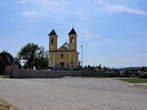
The Church of Our Lady is located on the plain along the main road in Log near Vipava. It is considered one of the largest and oldest pilgrimage churches in Primorska. The church was built in 1619. Already in the 10th century, a chapel was supposed to be built in its place, but the church was first mentioned in written sources in 1430. The Church of Our Lady is a three-storey building with three bell towers. Today's building dates back to the beginning of the 17th century and was enlarged and renovated in the 19th century. At that time, Geraldon, a Venetian sculptor, rebuilt the grand altar in classicist style. The side naves were turned into eight chapels and baroque altars were erected in them. In the presbytery of the church are frescoes by the painter F. Kurz von Goldenstein from the mid-19th century, the first example of Nazarene painting in Slovenia. The church accommodates about 4,000 people and is often the venue for major ceremonies. Next to the church is a monument to the pioneer Paul Rostas, a Hungarian commander who fell in fierce battles with Napoleon's army. Near the church is the famous Renaissance mansion Zemono, which is a popular destination for romantic weddings. In the basement there is a top catering restaurant Gostilna pri Lojze.
The parish Church of Saint Cross is of ancient origin, probably dating back to the 9th century, as evident from some architectural elements preserved in the Gothic presbytery. The church was remodelled in Baroque style in 1756.
The Koper Bishop Paolo Nadlini said in his Conografia Ecclesiastica from 1700 that the church was adorned with five altars. The arches of the chapel with the main altar and the image of Jesus Christ were made of stone and the chapel was used as the presbytery. The sixth altar, which was dedicated to the Divine Name, was dedicated by Bishop Hieronim Rusca to the brotherhood of rural priests in 1624 with the obligation that an appropriate number of masses be said for each member of the brotherhood at the time of the passing. The religious brotherhood flourished for a few years and later dissolved. After its revival in 1698, it was limited to priests from the Kubed church district and it included only public curates and no other priests, while the bishop was the one to determine the manager and leader. One of the brotherhood's tasks was to take care of the Altar of Saint Cross, the parish patron. The brotherhood was open to all the overlords to join as its brothers. In the post-war period, Marezige increased efforts in agricultural restoration and development. The traditional refosco holiday featuring wine tasting and presentation of old traditions and customs has been held sicne 1972. The village has a vast wine cellar that opens on Saint Martin's Day and the refosco holiday. The inside of the church was painted in 1932 by the Koper painter Ermengildo de Troy.
It is adorned with a stone custodia originating from the time of the Baroque remodelling of the interior and the wooden pulpit. The bell tower (23.28), which is separate from the church, was constructed in 1870 when the church was expanded with a choir.
Murska Sobota is the central point of the Pomurje, northeasterly part of the Slovenia. The city is also called Sobota. Evangelical Church is located in the Slovenska Street, near the Town's park. Its beginnings go to the 16th century. At that time the reformers like Jurij Dalmatin, Primoz Trubar, Sebastjan Krelj and others put the foundation to the Slovenian language. They were published the first printed books in Slovenian language like the Catechism, the Bible, textbook. It was built in the Neo-gothic style in the year 1910. The plan was made by the architect Ernoj Gerely. Interior of the church is also in this style. It is painted in the Hungary spirit. Inside you can see the altar with the painting of taking down the Jesus from the cross, which was made by the painter Jeno Bory. The Evangelic church community was established in the year 1783. Believers were at beginning from the rural class, but there were also some wealty middle class people, tradesmen and educated people. Today the Evangelical Church is represented in public life by senior and inspector as the presidents of the Church. They publish the Evangelical calendar and the monthly magazine Evangelical leaf.
The St Anne chapel is located on the slope of the small hill in Rogaska Slatina. It was built in 1804 and consecrated to holy Anne, who was the patroness of the health resort. The chapel is one nave neoromanesqe building. Inside we can see the altarpieces of St Mary with the child and St Anne, which was painted by the baroque painter Hans Adam Weissenkirchner in the year 1686. The St Anne chapel was renovated by the plans of the famous architect Joze Plecnik in 1926. In front of the chapel is the monument of St John Nepomuk, which was erected in 1732.
The parish Church of the Immaculate Mother of God in the old village centre was probably constructed on the foundations of a pre-Roman church from the 11th century. They began renovating and expanding the church in the early 13th century.
In 1222, the renovated church was consecrated by the Bishop of Koper Beato Assalone, which is testified to by the stone plaque on the outer south wall. In 1730, under Mayor Anton Rojc, the church was reconstructed again and expanded but it did not receive its current image until 1925, when it was altered according to the plans of Giovanni Mayer from Koper. It was consecrated anew on 8th December 1926. The interior is modest and simple, as the church was robbed in 1831. The only valuable object from its once rich legacy is the Glagolitic missal from 1631, reminding us of the former Slavic service (abolished in 1833). It is now kept in the parish archives. The stone stoup made by the sculptor Norbedo from Koper dates from 1933. The single nave church has a flat ceiling and a polygonal presbytery with a dome above the altar. In 1700, Bishop Paolo Naldini reported in his Corografia Ecclesiastica that the inside of the church was aborned by the five beautiful altars. In the church bell tower, which is made of rectangular sandstone like the church, there is a clock and a stone window dating back to the 19th century, the remains of the oldest church here.
There were three other churches in the village in addition to the Church of the Immaculate Virgin Mary but only the Church of St. Anthony the Hermit remains in the cemetery. The church was consecrated in 1488 by the Bishop of Koper Giacomo Valaresso.
 KRAJI - Slovenia
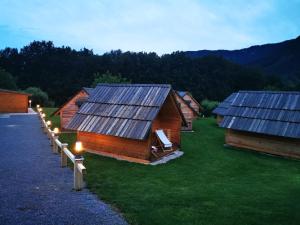 RadovljicaSmall wooden houses and Apartments Zgornja Dobrava