Source: Public information of Slovenia,
The Surveying and Mapping Authority of the Republic of Slovenia,
State map in measure 1 : 1.000.000, 1995
www.gu.gov.si
Recommended
Castle Kamen is situated in the village Begunje on narrow passage, which closes valley of Draga. From former powerful castle are today remaining only ruins, which are exemplary ordered and protected before further decaying. Every year they light a bonfire, celebration in honour of nationality – 25th of June and archery tourney. We trace the first records of castle Kamen in the 12th century, when it was still in the property of landlords of Kamen. In the year of 1261 passed over to property of Ortenburzan and later Celjan's, but there is no exact information. Valvasor is reporting, that has here from falling down out of horse killed Herman III., son of Herman II. Celjski. After their extinction in the 1428 has the castle Kamen passed over to possession of Habsburzan's. Owners have later frequent exchanged. Between them was also famous knight Gasper Lambergar, winner of 85 tournaments, which is also praised in national song of Pegam and Lambergar. In 18 th century castle was gave up.
Rising 475m above the city of Krancelj on a prominence stands Loka Castle. It was built on the edge of a natural terrace and below the castle a settlement of merchants and tradesmen grew up. It was first mentioned in a document in 1202 which stated it to be a resistantial castle. The first castle was build by the Freising Bishops and was the seat of the Manager or Head. The bishop when he came to see his dominion also stayed here. When it was almost completely destroyed by an earthquake in 1511, Bishop Filip ordered it to be rebuilt. In the castle’s courtyard was a powerful tower whose foundations are still seen today. Today the castle is part of the Loka Museum where you can see the cultural, ethnological, historical, Artistric, natural and scientific wealth of the Skofja loka region. Near the castle is a place used for concerts and walks that are wonderful during the summer. Into the city we can come down on the way near good preserved city wall that protect city many centuries.
Bled Castle is a powerful castle on the rock above Lake Bled. According to written sources is one of the oldest castles in Slovenia. Bled Castle is beside Bled island a symbol of Bled and Slovenia. From the castle are wonderful views to the lake with an island, Julian Alps, Karavanke, Lesce, Radovljica and other surroundings. The castle was donated with the deed of donation from Henrik II. to Brixen bishop Adalberon in 1011. The name Bled was in medieval written sources first mentioned in the German form Veldes. In Gorenjska Region Bled Castle was the administrative centre of the Brixen land property. Bled and its beauty was described by many travelers, among them was also Janez Vajkard Valvasor in 1689. Later Brixen bishops leased property and the castle also to others. During Napoleon’s occupation the Bled estate belonged to the Illyrian Provinces. In 1838 the Brixen bishops got the property back, but they sold it to the owner of the Jesenice ironworks, Viktor Ruard in 1858, because of too high costs. In 1882 Viktor Ruard sold the castle property and the castle to the wholesaler Adolf Muher. The next owner was the hotelier Ivan Kenda, who wanted to arrange the castle to a hotel. The bank seized all his property in 1937 and after bank the property got the Drava Province. Bled castle has buildings arranged around two courtyards. Farm buildings were on the lower yard and the residential area was on the upper yard. Buildings are from the Renaissance and city walls are Romanesque. Today is the Bled castle in the property of the state and managed by the cultural institution of Bled. Bled Castle was throughout the history scene of protocol and diplomatic meetings at the highest levels. The castle was renovated and arranged to tourist visits in years from 1952 to 1961 by plans from the architect Tone Bitenc. The museum part of the castle was renovated in 2008.
Other
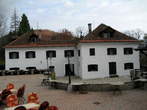
Bohinjska Bistrica is the largest village in the Bohinj valley and seat of the community. It is situated between hills Ajdovski gradec and Dobrava and between brooks Bistrica and Belica. The village divides road from the railway station to the Lower and Upper village. In Bohinjska Bistrica are railway tunnel, sports hall, open playground for tennis, football playground, elementary school, bus station, museum, restaurants, shops, private hotels, hotel, health service, local office, tourist informative centre, fire station, monument in memory of Second World War, Zois Manor with Tower Clock, First World War Military Cemetery, the Church of Saint Nicholas, ski center Kobla and other. Next to Aquapark Bohinj is located interesting and beautifully arranged Ceconi’s Park. The Zois Manor with Tower Clock was built in the neo Romanic style in the second half of the 18th century. Above the entrance doors we can see the famous arms. The manor was the residence and administrative building for iron entrepreneurs. In the Lord's garden, which is across the road in the southern side of the castle, is the Zois clock. Baron Ziga Zois built it that ironworkers would come in right time to the work. Ziga Zois was the ironworker, botanist, mineralogist, regenerator and the patron of the Slovenian literature. The castle and other buildings are today reorganized to the restaurant in the medieval style. They can accommodate 80 guestes. By the brook Bistrica they offer place for group and family picnics. Zoisov grad Restaurant serves twenty-five varieties of pizza from the open-hearth oven, original dishes, house specialities and chef's specialities such as Bohinj trout, Zois steak with boletus mushrooms, Emperor steak with asparagus, the Manor platter and other delicious food.
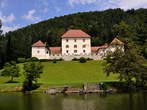
Castle Brdo was built in the first quarter of the 16 th century. The renaissance mansion was built by aristoctratic family Egkh. Plans for the castle were made by Italian master builders. They also arranged the garden, ponds and orchard. In the castle were later living the family Gallenberg, family Zois and Prince Karađorđević. Brdo was after the Second World War nationalized. The castle was renovated and equipped with period furniture, fine art, carpets and many other. With the renovation castle lost its renaissance design. Brdo became the Slovenian residence of Josip Broz Tito, president of the former Yugoslavia who hosted many world economic, political and other personalities. Today is Brodo a protocol building, which serves the needs of the Government of the Republic of Slovenia. Here are taking place the highest protocol meetings, conferences, congress events, special private and official ceremonies and many other. The area covers about 500 hectares of land with gardens, walking paths, ponds, orchards and forest.
The Lake Crnava and Hotel Alma & Grad Hrib are situated in Preddvor. They are popular places for many local people. They are also starting-points for trips to the saint Jakob, Potoska gora, Kalisce, Javorjev vrh, Srednji vrh, Cemsenik, Storzic and Hudicev borst. The Preddvor manor in the middle of the village was between second world war private hotel for holidaymakers. Today is youth house. The Castle Hrib was reorganized to the restaurant and they also have weddings. Beside the castle is an old avenue planted with old trees on both sides. The old legend promises to the fresh married couple, if they walk through this promenade, 50 years of faithfulness. Beside the castle they damed up the brook Bistrica, which flows from the back of the Potoska gora and supplies the artificial lake Crnava. Hotel Alma has a terrace, from where we can enjoy in wonderful views to the mountaints and to the lake. In summer time is possible to borrow the boat, hire a tennis place and in winter time we can slide. Around the lake is a good walking path. In the Bistrica valley, beneath Zaplata, is the rock climbing. It is only half an hour walking from the Lake Crnava.
Pustal is suburban settlement in Skofja Loka. It is situated in right bank of Poljanscica. Pustal is accessible from the town over bridge Pustal and on foot by Kopaliska Street over wooden footbridge Hudiceva brv (Devil footbridge), in which is also a mark. River under footbridge Hudiceva brv is spuming and rapid. Worth seeing are also Pustal's castle, church saint Kriz on Hribec, Nace's house, Policar house and baths, which are rather neglected. Pustal's castle was built in the year 1220. In that castle lived family Pustal, which has extincted at the end of 16th century, followed by a lot of other owners. Castle's chapel has marvellous fresco »Snemanje s križa« of Quagli from the year 1706. Now are in former castle in the two-storeyed building with arcades yard, apartments. Up to baroque church of saint Kriz we come on walking passing 12 Stations of the Cross. On Policar's house is marked up to where was stretching water at the big flood in the year 1926. Nace's house is museum and monument of Slovenian cultural heritage. It is the example of old Slovenian home, which has preserved original external form and old interior equipment. History of this house extends in the beginning of 15th century.
Stara Loka is part of Skofja Loka and belongs to oldest Slovenian settlements. It is primary Loka and in the year 1286 is first named as Stara. Worth seeing in Stara Loka are church of saint Jurij and Strahlov or Staroloski castle, beside there is also a small park. Church of saint Jurij is one of the oldest in Kranjska, it was built round 1118. Church was several times changed and rebuilt, so it has lost primary appearance. In the chapels are tombstones from 16 and 17th century. Present newromanic appearance got it at renovation in the year 1863. Beginnings of Staroloski castle go back to the 15th century. Since the year 1999 is announced as a cultural monunent national importance. Speciality of the castle are round towers, which were used for defence. Around the wall was also a moat, which is now filled up with earth. In the castle rooms are today the Centre of blind and weak-eyed and the Museum of post and telecommunication.
 KRAJI - Slovenia
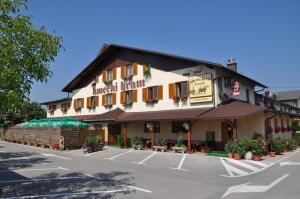 LjubljanaPenzion Kmečki Hram