Source: Public information of Slovenia,
The Surveying and Mapping Authority of the Republic of Slovenia,
State map in measure 1 : 1.000.000, 1995
www.gu.gov.si
Recommended
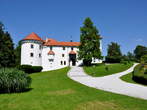
Castle Bogensperk is one of the most significant Renaissance castles in Slovenia. It was also home of the celebrated polymath Johann Weichard Valvasor. The castle was built by the Wagen family, feudal lords of the near by Lichenberg castle.
The first documented records date back to 1533 when Jorg Wentschitsch is mentioned as the castellan. The castle remained the property of the Wagen family until 1627, and had several subsequent owners before being bought by Johann Weichard Valvasor (1641-1693) in 1672. Further to the extensive library and a collection comprising 7,752 graphic prints and drawing by 15th-17th century European masters, Valvasor founded a graphics enterprise and a workshop employing a number of artists and copperplate engravers. In a twenty year period he wrote and published six works of a topographic historical nature and three with a more artists mofit. Valvasor's magnum opus and most famous work was the multi volume Glory of the Duchy of Carniola published in 1689. The publication of the Glory was a massive undertaking which got him into financial difficulties, and in 1692 he was forced to sell the castle. It then had a succession of owners, before becoming a home of Windischgraetz nobility, who were forced to relinquish the property at the end of the Second World War.
Castle Bogensperk was plundered during Second World War, and after the war it was used by the Jesuits for some years. A gradual renovation began in 1972. Today, Bogensperk houses a museum containing exhibition collections pertaining to Valvasor and his era.
Ljubljana has been the capital city of Slovenia since 1991. It is a popular tourist destination that attracts visitors throughout the year. It was first mentioned in written sources around 1120.
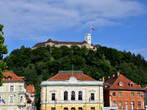
Today, Ljubljana is the cultural, administrative, transport, economic, political, research, and educational center of Slovenia. Ljubljana Castle, a mighty medieval fortress, is a symbol of the capital. It stands on the edge of Castle Hill, just above medieval Ljubljana. You can reach the castle by car, take the funicular railway from Krek Square in the old town, or walk along one of the well-maintained trails. Ljubljana Castle evolved from a fortified tower with a defensive wall, even before the first mention of Ljubljana. On the hill where the castle stands, human presence has been confirmed since the late Bronze Age. Throughout its rich and varied history, Ljubljana Castle has undergone many changes and witnessed important events that influenced the development of Ljubljana and Slovenia. At the end of the 18th century, the Habsburg owners wanted to abandon it, but did not demolish it due to protests from the Carniolan provinces. The castle was purchased by Mayor Ivan Hribar on behalf of the city in 1905, and he transformed it into a cultural center. In the early 20th century, the city of Ljubljana bought the building, and many renovations began, with plans drawn up by well-known architects such as Plečnik, Mihevc, Kobe, and Ravnikar Jr. The castle's current appearance is the result of the efforts and ideas of Projective Bureau Ambienti d.o.o. from Ljubljana.
Their contributions to the renovation include the funicular railway, the Slovenian History exhibition, the Erasmus Tower, the Frederick Tower, the circular route around the castle, the lapidary and mini-theatre, the archers' tower, the castle inn, wedding halls, the bastille, the Puppet Museum, Hribar Hall, the wine cellar, terrace, and more. Today, Ljubljana Castle is an extremely attractive tourist destination and hosts many concerts, cultural events, film and theater performances, and exhibitions. Visitors can explore various parts of the castle, such as the tower, the Chapel of St. George, the permanent exhibitions on the Penitentiary and Slovenian History, Dwelling Hall, Frederick Tower, Frederick's Room, the Arts Sales Gallery, Shooter Tower, and the Pentagonal Tower. The Virtual Castle offers a 12-minute projection on the history of the castle, its architectural development, and archaeological findings.
The Castle Cafe serves typical Slovenian dishes with a modern twist, while the Castle Cafe offers a wide selection of coffees, beverages, fruit bowls, cocktails, and desserts. During the summer, the castle courtyard hosts various events, the most popular of which is the "Movie Under the Stars" screening.
Other
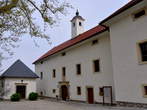
Zgornji Tustanj is a small village in the Municipality of Moravce in the central part of Slovenia. Tustanj Castle is located on a hill southwest of Moravce and southeast of the road to Vrhpolje. The castle was built in 1490 and got its present form in the year 1671.
Tustanj Castle offer – attend castle cultural events, organisation of field trips for kindergartens and schools, organise seminars and events in a unique castle ambient, experience an unforgettable wedding (a church and a civil ceremony in a standard wedding dress or in a medieval costume), learn about life within the castle walls on a guided tour. By prior arrangements, groups will be served home made delicacies. Tustanj Castle is among the few amazing castles in Slovenia in which an original collection of porcelain, furniture, land register, documents, tiled stoves and other antiques are kept. The first nobility mentioned is the Lichtenberg family. Tustanj Castle is the only preserved castle from the six castles that once dominated the Moravče Valley. It was home to many noble families for more than 500 years of its exsistence, it has a rich history and many interesting stories to tell. The most famous of all of them is the one about how the castle passed over from the hands of noblemen into the hands of the ordinary Slovenian family of Pirnat, a castle gardener.
Tustanj castle has an arcaded courtyard and four corridors with halls that guard the pearls of the interior furnishings dating from the lifetimes of past nobility. The beautiful castle park preserves a large plane tree and a small pond.
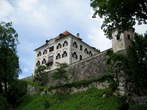
The Castle of Zaprice is one of the biggest cultural sights in Kamnik. It is situated on the small hill above the town and there were two castles already in that place in the past. The Castle of Zaprice was built by aristocratic family Dienger von Apecz. In the first half of the 16th century was renovated by Jurij Lamberg. The primary medieval castle was surrounded with walls with two towers and corner balconies. In Vajkard Valvasor famous book The Glory of the Duchy of Carniola from the year 1689 we can still see the renaissance appearance of the Castle of Zaprice. In the castle were meetings of local Lutherans in the 16th century, but after the year 1574 their ceremonies were forbidden. In the 17th and 18th century the Castle of Zaprice was increased, rebuilt and it got the baroque style. After the year 1945 the castle was nationalized. Today the Intermunicipal Museum Kamnik is in the Castle of Zaprice, which was open in the year 1961. In the museum we can see periodical and permanent exhibitions. Lapidary – the collection of stony testimony of the human activity from antique until today is situated in the ground floor. In front of the Intermunicipal Museum Kamnik is on the grassy area the open air museum – ethnographic museum, which shows the granaries from the Tuhinj Valley.
The Old Castle is a castle above the city Kamnik, where are nowadays only ruins. We can go to the castle from different directions. If we walk, we can start by the marked way near the centre of Kamnik. It takes about 30 minutes. Somewhere on the half of the way is the Little Wooden Mills Grove,where are lots of small mills. This part is especially interesting for children. We can also drive by the asphalt road, which begins by the health centre. The Old Castle was built in the 12th century by Andeski Counts. The castle above Kamnik belongs to the one of the oldest castles in Gorenjska Region. Because of its good strategic position the owners could control the traffic roads, which went near the Kamnik. Today it is situated the restaurant Grof Andes near the Old Castle.
Polhov Gradec Mansion is situated in Polhov Gradec and it is the main attraction of the place. It lies between Polhograjska Gora and Kalvarija and it is a little bit far from the old village centre. Before the mansion is a wonderful park with a a hundred years old lime tree and the Neptun fountain with colums with nymphs from the year 1696. The mansion complex also has an English tower with clock, mansion farm, stables, mansion laundry, drying house for flax and other. The Polhov Gradec Mansion has a varied historical past. The upper old manor was built in the 13th century. In the earthquake in the year 1511 was very damaged, so it was not renovated any more. The owners moved to the lower tower mansion, enlarged it and strengthen before Turks. Under the ownership of the baron Khisel at the end of the 16th century the building got the renaissance style. The present image with the additional baroque style the mansion got around the year 1700, under baron Kunstel. Today the Polhov Gradec Mansion is renovated, but not the whole complex. In the mansion is a local museum, which shows the historical happening and a life in the village, wedding room and e-point. In exhibiton rooms are organized cultural and other performances. Polhov Gradec Mansion is a wonderful place for a romantic wedding.
 KRAJI - Slovenia
 KranjPR`FIK Apartments