Source: Public information of Slovenia,
The Surveying and Mapping Authority of the Republic of Slovenia,
State map in measure 1 : 1.000.000, 1995
www.gu.gov.si
Recommended
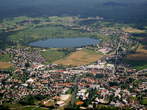
Brezice is the administrative, economical and cultural centre of Brezice country and surrounding hills. It is located near the confluence of Krka and Soca Rivers. As the administrative centre of Salzburg archbishops the city developed by the Castle Brezice, where is today the museum. In the beginning the castle was only the wooden stronghold. The settlement was first mentioned in the year 1322. Through the city went the trade road from Styria and Carniola. Today in Brezice are developed transport trade, industry, wholesale trade, manufacturing trade and other. The city is the school centre of Posavje Region. In the city we can see the Parish Church of St Laurence, which was built in 1782, the Church of Saint Rok, which is from the year 1740 and was built because of the severe fever, water tower, Aqueduct tower, Castle Brezice, Castle granary, old pharmacy, the house of family Del Cott, Town Hall and many other. The Aqueduct tower is visible far away and it is the most known point of the city. It was built in the year 1914 and is 46 meters high. Today is in it a coffee shop with three floors. We can also see original old instruments. The tower is a symbol of Brezice. The Castle Granary is one of the best preserved granaries in Slovenia. In the former castle stables in now the Music School Brezice. In the old pharmacy is the well known restaurant Santa Lucija. In the German house is the courthouse.
The Otocec Castle is situated near the city Novo mesto in Dolenjska. It is the only water castle in Slovenia and it stands on one of the island of the Krka River. Its image was formed through the centuries. The beginning of the castle goes back to the 13 th century, in the year 1252. The name Otocec originates from the Freizing bishops. The owners of the castle were named knights from the island – de Werde or islander. In the minddle of the 14 th century the building was widened and it got the ground plan of the letter L. The Castle Otocec was additional strengthened after the Turks devastation in the year 1471. In the second half of the 16 th century it got the renaissance appearance. In the second half of the 17 th century the castle building got among the other renovations also the arcade corridors in the ground floor and in the both floors of the southern tract. Between the Second World War the Castle Otocec was destroyed by fire from the partisans and in that time were ruined the precious archives in which was hidden some interesting stories from the rich history of this wonderful castle. After the war the castle was nationalized. Today is in the castle the Otocec Castle Hotel, which is very luxurious and a restaurant with the best culinary offer. Near the hotel, in the right side of the river Krka, is situated pleasant Camp Otocec. About 300 metres from the castle is the Sport Hotel and a motel, which is designed mainly for travellers in transit guests. We can get fun in the Sport Hotel, where they have gambling rooms. For business meetings is available congressional hall. At the weekends is possible to dance in the restaurant Tango at the sounds of the live music. The Otocec has also developed to sport centre, which offers excellent conditions for running or cycling and guests can play tennis, golf and other sports. The River Krka invites us in the upper current to rafting, under the castle you can go boating or fishing. The Hotel Otocec is the ideal place for romantic and unforgettable weddings, where guests can feel like kings. They offer arrangements like Castle wedding in Chivalric saloon, Castle wedding, Wedding in the open air, Romantic wedding in the shine of the torchs and candles, Wedding in the open air with bridesmaid and senior, Lords wedding and Wedding in the dreaming river Krka. In last years are very popular weddings in the open air under the tent in the Castle Otocec park. The park is shaped after the patterns of the English landscape style. The oldest trees are old almost hundred years and mayority was planted after the renovation of the castle in the 50 years of the 20th century.
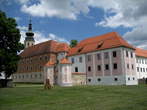
The Bozidar Jakac Gallery is situated in Kostanjevica na Krki. It was established in the year 1974. Most of the pictures are from expressionists. The first starts of the gallery goes back to the year 1956, when was in the places of the elementary school established The Gorjup Gallery. The Gallery Bozidar Jakac is situated in the rooms of the former Cistercian monastery, which the local people also call it Kloster or Kostanjevica Castle. Before the entrance to the gallery is beautiful lime avenue, which in summer times gives nice shadow. The Church of the Virgin Mary and the cloisters are the oldest part of the monastery. The church originates from the middle of the 13th century. In the 18th century was renovated to the baroque style. The wall above the main entrance was painted in the year 1737 by Franc Jelovsek. In the 19th century the monastery was condemned to dilapidation, but the worst part was, when the monastery was burnt down between the Second World War. Furthermore, in the year 1956 was destroyed the church tower. The renovation began soon after the war, under the direction of the France Stele. It is still continuing today, under the cover of the group of the institution for the protection of the natural and cultural heritage. In the gallery are permanent exhibitions of Joze Gorjup, Tone Kralj and Bozidar Jakac. Gradually, with renovation of the rooms, the gallery has the exhibitions of France Kralj, Zoran Didek, France Gorse and Janez Boljka. Specially interesting is the art collection of old masters from the nearby Pleterje monastery. The castle grounds are used to exhibit over 100 large wooden sculptures from Forma Viva, an international exhibition once held in several places in Slovenia from 1961 to 1988 whereby sculptors worked with materials assosiated with the area. Here it was oak, in Portorož stone, iron at Ravne in Koroška and shudder concrete in Maribor. In the future Forma Viva will be organized every two years. Lamut Art Salon is dislocation of the gallery and is situated in the city centre. The painter and graphic artist Vladimir Lamut completed a large portion of his work here in Kostanjevica.
Other
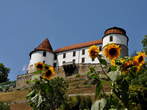
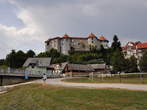
Castle Bizeljsko (Wissel) is situated on a rocky hill above the village Bizeljsko. Castle gives the village its characteristics appearance. In written sources is first mentioned in 1404, when the region was inhabited by knights Wissell. The castle has a medieval layout. Throughout the centuries has played an important role as a defensive post. Today the Castle Bizeljsko has Renaissance and Baroque features. Renaissance form can be seen at the entrance, when the Chapel of St. Hieronim with rich Baroque altar was added to a building. The chapel originates from 1623. The arch of the chapel and three rooms on the first floor are decorated with stuccos from the late 18 th century. Rooms were built as a series of continually spaces. A rectangular courtyard is surrounded by four two -storeyed tracts. On the west side are at the corners round towers. In the Castle Bizeljsko did not keep the valuables, because everything took away its last owners, counts Windischgraetz. Today is in the castle the wine chapel Klakocar. The family Klakocar also restored the castle rooms. We can see the rich wine cellar and the castle chapel. Beside famous wines from Bizeljsko is in the cellar preserved the autochthon sort named Rumeni plavec.
Krsko is the central and commune town of Posavje region. The city has developed on both banks of the longest Slovenian river Sava. It also has varied historical past. The old town centre was renovated. New part of the town is situated in Videm. This part was arranged at the same time with the finishing of the nuclear power station Krsko and the largest paper factory in Slovenia. The city is the cultural centre of its region. Major important buildings are the church of Saint John Evangelist, church of the Holy Spirit, Culture House Krsko, Valvasor's Library near city park, the Gallery Krsko, Capuchin monastery with the church, Hall in the Park and before it you can see two half-length bust of the most important citizens of the city: Jurij Dalmatin and Adam Bohoric, who had strongly marked the time of Protestantism. In Krsko lived Janez Vajkard Valvazor, who wrote the famous book The Glory of the Duchy of Carniola (Slava vojvodine Kranjske), published 1689. You can see his monument and the house. The famous residents are also Martin Hocevar, benefactor and merchant and Janez Mencinger, writer and lawyer.
 KRAJI - Slovenia
 PreddvorHotel Oskar Zaplata