Source: Public information of Slovenia,
The Surveying and Mapping Authority of the Republic of Slovenia,
State map in measure 1 : 1.000.000, 1995
www.gu.gov.si
Recommended
Koper is the main center of the Koper Municipality. The city has two official languages, the Slovenian and the Italian. Koper has an architecturally very rich old city center. It was built on a rocky island which the Romans called Insula Capraria (goat’s island).
Koper saw great economic and cultural blossoming in the years from 1279 to 1797, when it was under the rule of the Venetian Republic. The remains of the Venetian period are visible in the city architecture which has preserved its medieval appearance in spite of the modern interventions. Because of that, Koper was included in the association of the medieval cities. At the beginning, Koper was an island, surrounded with walls and connected with the land by a wooden bridge. It was safeguarded by a powerful fortress, the Lion’s castle. Around the city there were extensive salt works. Koper began to change due to the economic and social development from the 19th century till the First World War, under the regime of the Napoleon French Empire and the Hapsburg Monarchy. By 1912, the salt works were reduced and finally abandoned. Koper slowly started to lose its character of an island and under the Kingdom of Italy it became an integral part of the mainland.
The period after the Second World War brought the final revision of borders, when Koper became a part of Yugoslavia and experienced architectural interventions in the city center and its surroundings. On the outskirts of the city the international cargo port was developed, Luka Koper. The harbour maintains its maritime connections with all parts of the world.
The Predjama Castle is located under the overhanging rock in the region Podgora, which is only 9 kilometres from Postojna, beside the village of Predjama. It is also called eagle nest of the robbery knight Erazem Predjamski, about who exists lots of legends. The Predjama Castle is carved in the vivid rock. It was existing already in the 13th century, probably sooner. It was managed by Jamski, which belonged under the Oglej property. After Jamski the castle was under management of the Adam Purgstaller and from the year 1567 were in it the family Kobenzl, who also provided for the renovation. The last aristocratic owners were counts Windischgrätzi from the year 1846 to 1945, which also changed the external image of the castle. The parts of the castle are different by style and by the time of the origin. The constructors used the advantages of the cave and with that they preserved the non conquery of the primary castle. The cave under the Predjama Castle is ramified with more parts with the several entrances. The most famous is the entrance through the Horse stable in which they discovered the traces of the minor stony and copper age and also from the Roman times. Today is in the castle museum, which is showing the medieval life of the knights. Amongst the interesting things are also residence rooms, chapel and prisons, some parts of the arms, oil paintings and Pieta from the year 1420. Every year is organized here the famous Erazem knight tournament, which attracts many visitors. The performance conjures up the former life in and beside the castle.
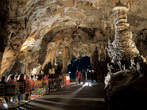
Skocjan Caves are located in the wonderful Karst in the nearness of Divaca. With the spacious halls and underground gorges they have a special place among caves in Slovenia. Skocjan Caves consist of eleven caves, sinks, natural bridges, sinkholes and many other. They are part of the World Heritage Register by UNESCO from the year 1986 because of its unique cultural and natural heritage. In the cave we can see curtains, large sockets and colorful, big stalagmites different forms. In Skocjan Caves is the main the Velika voda – Reka, which flows booming in rapids, falls in waterfalls and slows in lakes and pools. Skocjan Caves can be seen in the company of experienced guides. The sightseeing takes about one and a half hour. In the tour we see Paradiz, Podorna Hall, Velika Hall, Tiha cave, which was discovered in the year 1904, Sumeca cave, narrow Henke channel from the Cerkvenik bridge, Sumeca cave, Schmidl hall and other. Cerkvenik bridge was built by plans of Franc Cerkvenik in the year 1937 and it was renovated in the year 2003. We can live the underground world by the footpath or we can drive with the elevator.
Piran is an old port town in Slovenian Istra. The town is bilingual, Italian and Slovenian. The Italian name for the city is Pirano. It is situated at the cape of the Piran peninsula. Piran has kept its medieval appearance with narrow streets and closely built houses, which gives it a typical Mediterranean character and a special charm.
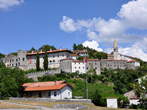
On a hill above the houses, the church of Saint George is situated, with a high tower and an interior with many paintings and intricate artwork. Piran has been settled since before Roman times. In the years between 1909 and 1953, Piran was connected with Portorož and Lucija by an electric railway. Today, Piran is an administrative and tourist center which attracts both local and foreign visitors. Some of the most fascinating sites in Piran include the Tartini Square, the Town Palace, the Tartini Monument, the Tartini House, special stone columns for flags, the Court Palace, the May 1 Square, also known as the Old Square, and the old town wall composed of three walls from different time periods. In the city center is the Aquarium which was established in 1964. The Promenade extends along the coast and offers many restaurants with a wide variety of local foods and drinks. Church of Saint George offers an extraordinary view of the old town and the Gulf of Trieste. It was built in 1638 on the site of the Romanesque basilica and the Gothic three-nave church. A bell tower stands independently of the church. It was built in 1609 after the model of the bell tower of St. Mark in Venice. Tartini Square was originally a seafront for fishing boats. It was demolished in 1894. In the middle of the square stands a bronze monument to Giuseppe Tartini, a famous Piran countryman, composer, violinist and music educator. The Church of Our Lady of the Snows is located along Bolniska Street. It was built in 1404 and rebuilt in the baroque style in the 17th century. Opposite the church stands the church of Saint Franciscan monastery. The monastery cross corridor with a portal is a remarkable work from the 17th century.
Narrow streets in Piran make it impossible to drive cars, so there are parking places in front of the city. Piran, Seča and Portorož are connected by a regular local bus route. A newer part of the town developed outside the walls along the coast towards Portorož.
Other
Sneznik Castle is the best preserved castle in Notranjska region. It is located under the mountain Sneznik near the place Kozarisce. The castle is built on a rock at the source of the Brezno Spring and the Obrh. Below the castle is the spring dammed into a large pond. In sources the Sneznik Castle was first mentioned in the year 1268 as the hunting post. The formation of the present castle goes to the year 1462. First owners were the Aquileian Patriarchs and later the owners changed several times. Before the war it was the property of the family Schönburg from the vicinity of Dresden. Sneznik Castle is a three storey building with a newer stone bridge that leads to the walls and Renaissance walls in front of the entrance. Two arched stone bridge and the outer towers are Romantic additions of the 19th century. In the castle is preserved all the original fittings, mostly from the 19th. You can feel the throb of life from the end of the 19th and beginning of the 20th century. Among the living quarters are the most interesting the room with Egyptian furniture, the dining room and a larger hall arranged into a wedding hall. The castle residents also had an improvised theatre hall and a small library. In vestibules and in all the halls you can see the numerous stuffed animals and trophies. The surroundings have been carefully arranged into a park with riding and walking paths. East of the Sneznik Castle are farms and other additional buildings that house a small hunting museum. Sneznik Castle is a wonderful place for a romantic and unforgettable wedding. The manager of the castle is the National Museum of Slovenia.
Hrastovlje is a village in the Commune Koper. It is located in the northwestern part of the Slovenian Istra under the Karst edge (limestone region). Houses in the village are markedly mediterranean or karstic type with many portals and archs of the limestone. Lots of houses is under memorial protection and because of that the procedures of the renovations are more complicated and they impede the aesthetic development of the place. Hrastovlje is most known by the Romanic Church of the holy trinity from the beginning of the 12 century, which is situated on the rising ground above the village. In the 16 th century they surrounded it with the high defensive, camping walls, which are still yet very well preserved, but they cover the view to the building. Outwards the church is simple and covered with stony plates as is the habit in Mediterranean. Most interesting and precious is its interior with three ship's architecture. The Church of the holy trinity became international known in the year 1951, when the frescoes of the Dead dance were uncovered by the patriotic sculptor Joze Pohlen. The church was ranged to the list of the world's cultural heritage. South of the village stands the stony statue called Savrinka by Pohlen, which was once the name for the women from Trieste who carried on heads their rustic harvest.
Lipica is situated in the wonderful Karst environment, close to the Italian border. It was founded in the year 1580 and it is the centre of the all Lipizzan hourses (400 lipizzan hourses today in Lipica). The Stud-farm of Lipica is one of the most beautiful cultural and historical monuments of the Republic of Slovenia. Here, the tradition of selection and breeding of pure Lipizzan hourses has been alive for over than four hundred years. After the Second World War, Lipica succeded to develop its own Classical Riding School and presented it in the presentations and equestrian events all over the world. Today is Lipica a recreational and sports centre of a worldwide reputation, where visitors can spend wonderful moments of relaxation. In the complex of Lipica is to the visitor available the Hotel Maestoso, Klub Hotel Lipica, tennis courts, golf course, mini golf, swimming pool, sauna, fitness centre, souvenir shop, museum collection of old carriages and many other. We can see one of the oldest stud farm in the world, the presentation of the Classical Riding School, racetrack, the collection of the art work in the Avgust-Cernigoj Gallery, the Church of the Saint Anthony of Padua and the Valley Our Lady of Lourdes. We can go to the riding school, golf and to the interesting drive with the carriage. In Lipica they also have a wedding hall for romantic weddings.
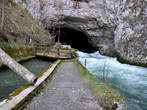
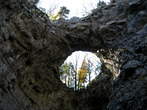
Rakov Skocjan is situated between Planinsko and Cerknica field. Skocjan was first mentioned in the 15th century. It got the name after St. Kancijan Church. In the book The Glory of the Duchy of Carniola from the year 1689 we trace the first noted description of the Rak valley. After the second world war, when the territory was still under Italy, they built barracks and circular road and made plans for the caves. In Rakov Skocjan flows underground stream Rak, which is the precursor of the river Ljubljanica. It is the karst valley, which was made when the roof of the underworld tunnel was destroyed. From the former arch they stayed only the Great natural bridge and Little natural bridge. Rakov Skocjan is 6 kilometres long and is the natural pearl of the Notranjska Region. From the year 1949 is protected as the landscape park. After the valley goes marked circular naturalistic way, where can be seen the most important natural and cultural remarkableness. The valley has its logical beginning in the affluent, east side with the Little natural bridge, where the brook Rak springs from the Zelske jame Caves. There also begins the naturalistic teaching path. After the visit of the sinks leads way by the right bank of the brook, opposite of the hotel crosses the wooden footbridge and continues it in the left side of the riverbed to the Great natural bridge and sinkhole Tkalca Cave. Afterwards the path goes up to the ruins of the St. Kancijan Church, where it ends. It is 3 kilometres long.
The Secovlje Salt - pans are one of the rare saltpans, where the salt is still produced in compliance with several centuries old procedures. They are extending at the mouth of a river Dragonja in Secovlje at about 650 ha of surface. In 2001, the Government of the Republic of Slovenia proclaimed the area of Secovlje Salt – pans a nature park and the Museum of Salt - making a cultural monument of national importance. Secovlje Solina Nature Park is divided in southerner and northern Park, which is separated by the Grande – Drnica channel. The northern part, which borders to Croatian boundary, is called Fontanigge. At Fontanigge the production of salt – harvesting was abandoned in the 1960s. Secovlje Solina Nature Park covers 6.5 square kilometres along the Slovene – Croatian boundary. The Secovlje Salt – pans are, together with the nearby Strunjan pans, the northern most and still active salt – pans in the Mediterranean. In the Museum of Salt – making you can see the producing of the salt in the way which origins from the 14th century. In the shop Lera you can also buy different souvenirs. In the first floor they have the room, where are organized varied exhibitions. In the Salt square is situated the administration of the park and they also have the centre for the visitors. On average, 2,000 tons of salt is harvested annually.
The botanic gardens of Sezana are situated in the north – eastern part of the town. Sezana has been the administrative centre of the Upper Carst since 1848, and was a commercial and traffic centre already before the date.
The trader family Scaramanga from Trieste was so enthusiastic about the location and the significance of the town that it build a summer residence. In the period between 1848 and 1880 they bought from the farmers the land of which the today's botanic gardens are located. A greenhouse was built in 1890 for those plants that are particularily sensitive to the cold weather. In the botanic park the Scaramanga family cultivated plants from many different parts of the world. They planted deciduous trees from North America, Japan, coniferous trees from Europe and Asia and evergreens from Mediterranean.
Officials fo the park have been completing since 1948 the selection of coniferous and deciduous trees as well as bushes by adding new plants. At the same time they enlarged the stock of plants within the greenhouse by achuiring new material from subtropic, dry and tropic parts of the world.
Socerb is an Istrian hamlet that lies in the Koper region. It is made from a series of homes that were formed nearer the Carst environment. Every home is a separate unit and its centre is a closed courtyard - Korta. Above the hamlet stands the ruins of the Socerb castle. The remains of the fortress lie on the edge of the Carst wall, on the border between Carst and Istria. Because of the extraordinary strategic position of the castle in olden times, the powerful castle had many landlords. It was already mentioned in the Middle Ages. In 14th century it was the property of the Venetian family Ducani. It was damaged any times due to wars. In the time of the National Liberation War it was in the middle of such battles. Today only some parts of castle walls have been renewed. Inside is a well-known restaurant. From the walls there is a splended view of Trieste and a large part of Istria. Next to the castle, karts cave Sveta jama (Holly Cave) is a site of particular interest. It is 44 m deep and 189 m long. Inside the cave s the only subterranean church in Slovenia. Legend says that the young St. Socerb lived in the cave after he converted to Christianity, and because of that he was executed by the governor of Trieste in 1284. Inside the cave a mass has been held every year on 24th May since the 2nd World War.
 KRAJI - Slovenia
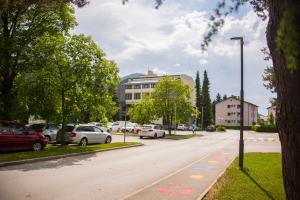 PreboldHotel Prebold