Source: Public information of Slovenia,
The Surveying and Mapping Authority of the Republic of Slovenia,
State map in measure 1 : 1.000.000, 1995
www.gu.gov.si
Recommended
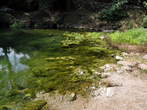
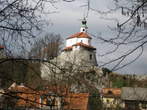
Bistra is a village, which belongs to the Municipality of Vrhnika. The village with a carthusian monastery is named by karstic springs which spring here.
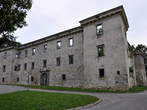
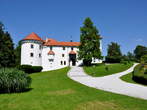
Bistra is well known by the monastery and later Castle Bistra, which is today a Technical Museum of Slovenia, the source of Ljubljanica River, a castle park and a forest educational path.
The beginnings of the monastery began in 1220, when duke Bernard Spanheim invited to Carniola first Carthusian monks. Bistra was one of four monastery of Carthusian monks in Slovenia. In the museum they have permanent collections from forestry, hunting, fishing, transport, woodworking, electricity, textile, agriculture, printing and other. In the collection of transport are interesting collections of cars before and after World War II., cars of Josip Broz – Tito, cars of national production, motorcycles and bicycles.
Castle park is very nice arranged and interwind with many walking paths. In this part is also a cafe and a pavilion for romantic weddings. The Forest Educational Trail is located directly above the museum of Bistra. From here is also a nice view to surroundings. It is about 2300 meters long and goes through beech and fir forest.
The Pekel Gorge is situated near the village Borovnica. From Ljubljana is about 23 kilometres away. It was made with the sank of the Ljubljana swamp. The Pekel Gorge was excavated by the Otavscica brook. In summer months is here pleasant and refreshing coolness. Before the beginning of the road is the information table about the Pekel Gorge. In the gorge you can see five waterfalls, which are in the winter time also suitable for climbing. Access to them is in some regions difficult because of the steep slope and because of that is necessary bigger caution. The first waterfall is the smallest and it is 5 metres high. The other four waterfalls are high from 15 to 20 metres. The fifth waterfall is the higher and they say the fourth waterfall is the most beautiful. The third waterfall is called Kozak because of the silhouette of the chamois in the rock beside the waterfall. The gorge has beside the foaming and wild water also wonderful animal and vegetal world. The symbol of the gorge is the Slovenian endemical plant the Carniolan Primula. Slovene name is Kranjski jeglic and latin name is Primula carniolica. It has beautiful red and violet blossoms. The plant blooms in April and May. The first one, who made footpaths in the gorge, were people who did the char wood and people who did not have their woods for firewood. Under and above the Pekel Gorge were saws and mills. In the glade before gorge is the Brancelj-Kosir mill, which was renovated in years from 1994 to 1995 by the members of the Tourist association Borovnica. Close to the parking place is the restaurant Pekel, which is famous by delicious home made food, especially by trout.
Volcji Potok Arboretum is located near Kamnik. The word arboretum means the collection of the trees and bushes, which is designed for education and researching. In the base the Arboretum is the botanic garden for woody plants and it is the only one in Slovenia. In the earlier centuries was the mansion property, but from the year 1882 was in the property of the Ferdinand Souvan and later of his son. He arranged the park with ponds and plantation of the exotic trees. The park is also called the Souvan park. The manor was between the Second World War destroyed by the fire. From the year 1952 the park is allocated to the agronomy and forestry faculty in Ljubljana. The Volcji Potok Arboretum is divided to: Francoski park, Stari park, Souvanova loka, Rozarij, Zgornji angleški park, Jelova draga, Spodnji angleški park, Hujski park, Južni park, Zahodni park and the forest in which is very important the rare union of the fir tree and tropical moss. In Arboretum, 80 hectare of ecologically very diversified ground is occupied by about 2.500 taxons of trees and shrubs. The number of perennials is different every year. In the Arboretum is six lakes. The newnesses they have announced in the web page. The exhibition of the orchids and tropical plants you can see in the greenhouse behind the old administration. Between them are flying beautiful tropical butterflys. In April they have the exhibition of the blooming tulips and spring flowers. In the park was on tour the Minimundus from Austria with the miniature buildings. The Arboretum also has the playground for children, which was renovated recently. Next to the playground is situated the granary and in front of it is the garden in which are cultivated herbs like marjoram, sage, tarragon, absinthe and many others. In the cafe you can get refreshing drinks, cakes, ice cream and they also have special daily offer. The Gallery Arboretum entertains the permanent collection of the sculptures from the statuary Janez Boljka. In the pavilion you can rest and enjoy in peace and silence.
Ljubljana is a vibrant and modern capital of Slovenia, one of the largest cities in Europe. It has been the capital of the Republic of Slovenia since 1991, when Slovenia became an independent state.
The symbol of Ljubljana is represented by the Ljubljana dragon, which is visible on the Dragon Bridge and in the coat of arms. Throughout its diverse history, the city has been influenced by several different cultures, since it was located at the crossroads of Romance, Germanic and Slavic nations with their customs, customs and languages. Today, Ljubljana is the cultural, geographical, economic, scientific, administrative and political center of Slovenia. The highest state bodies, the Parliament of the Republic of Slovenia, the President of the State, the Supreme and Constitutional Courts, the Government and a number of consulates and embassies operate in Ljubljana.
There are many primary and secondary schools and a university in the city. The center of cultural events are Cankarjev dom, Slovenian Philharmonic, Opera and Ballet theaters, SNG Drama, galleries and museums. National and University libraries stand out among the libraries. The biggest attractions in the old town are the Ljubljana Castle, which is a recognizable building by far, Franciscan Church, Triple Bridge, City Hall, Robb's Fountain, St. Nicholas Church and many more. Since 2006, Ljubljana Castle has been connected to the old town by a funicular. Famous Slovene architect Jože Plečnik left a great mark on urban architecture between the two wars.
The picturesque Ljubljanica River, which winds through the city, crosses many bridges, the most famous being the Dragon Bridge and the Triple Bridge. The hustle and bustle of the capital is mitigated by many smaller city parks, large green spaces such as Tivoli Park and the location between forested areas. Ljubljana also has the Ljubljana Zoo, which was founded in 1949 and the interesting Ljubljana Botanical Garden, which has been operating since 1810. By setting up a sports hall in Tivoli and a modern Stozice Center, which covers a multi-purpose sports hall and a football stadium, Ljubljana has become an internationally renowned sports center.
Outside the city center there is a larger shopping, sports, entertainment and business center - BTC City. Popular excursion points for Ljubljana residents in the city and the surrounding area are Sisenski hrib, Katarina, Tosko celo, Rasica and Smarna gora.
Velika Planina is the high mountain plateau located in the foothills of the Kamnik-Savinja Alps, where the best preserved herdsmen settlement in Europe is located. The fastest and most common access is by cable car from Kamniska Bistrica, where parking is located. When you arrive at the top, it is possible to us a chair lift that will convey you to the Gradisce. A little further on, one can see the wonderful view of the herdsman settlement. On the other side are the high mountain peaks of Grintavec, Skuta, Brana, Ojstrica, Planjava, Lucka Baba, and Kamnik saddle. There are about 140 cottages on the plateau, all designed by the architect Vlast Kopac. Rich alpine flora and grassy slopes, Carst sinkholes, larches and pine trees create a fairytale landscape, perfect for an all-day trip. One can rest by the Chapel of Marija Snezna, or one can choose to walk down to the cave of Vetrnica that is accessible by a circular path. There are, in fact, two caves: Mala (small) and Velika (big) Vetrnica that are connected by a natural bridge. The caves are the result of a high alpine environment where snow is still to be found even in the summer months. On the western border of the plateau (Zeleni rob) lies the picturesque natural window Luknja. There a also a few mountain huts on the plateau: Domzalski dom, Dom na Mali planini, and Domzalski dom Mountain Hut. In winter, there is a ski slope that offers good skiing and winter beauty.
Other
Sticna Abbey is situated among Dolenjska hills. Among the rare working cloisters is the only one, which belongs to Cistercian monks. The Cistercian order originates to the year 1098 to Burgundija in France. It got the name by the place called Citeaux. The founders were three saints, which were the benedictine monks from the monastery in Molesme. The Sticna Abbey is today the important cultural and religious memorial. It was established from the patriarch Peregrin I. At that time it also got lots of property. The monks Cistercians have beside prayers dedicated lots of their time to charity, work and economical activity. From the 13th century they also work on pastoral soul. In the second part of the 15th century had experienced many attacks from Turks and had crisis in the 16th century. The new blossoming was in the 17th century. That lasted till its disbandment in the year 1784. The abbey was again inhabited in the year 1898. It is the oldest in the Slovenian territory. In Sticna Abbey lived well-known Slovenian medical man Simon Asic. Here were also educated Anton Tomaz Linhart and Jakob Petelin Gallus. The complex of the abbey is composed from the Romanic cloistral church – basilica, which was in baroque twice renovated, early Gothic cross – shaped corridor with frescoes and the line of the buildings with the change from the 17th and 18th century. In the first floor are museum and gallery collections from the Slovenian religious museum. Part of the garden in the walls at the southern side comprehends meditative park, which is completely distant from the other areas and ordered like the peaceful, green grass. In the shop you can buy well – known herbs of the Simon Asic and products of other monks.
Castle Bogensperk is one of the most significant Renaissance castles in Slovenia. It was also home of the celebrated polymath Johann Weichard Valvasor. The castle was built by the Wagen family, feudal lords of the near by Lichenberg castle.
The first documented records date back to 1533 when Jorg Wentschitsch is mentioned as the castellan. The castle remained the property of the Wagen family until 1627, and had several subsequent owners before being bought by Johann Weichard Valvasor (1641-1693) in 1672. Further to the extensive library and a collection comprising 7,752 graphic prints and drawing by 15th-17th century European masters, Valvasor founded a graphics enterprise and a workshop employing a number of artists and copperplate engravers. In a twenty year period he wrote and published six works of a topographic historical nature and three with a more artists mofit. Valvasor's magnum opus and most famous work was the multi volume Glory of the Duchy of Carniola published in 1689. The publication of the Glory was a massive undertaking which got him into financial difficulties, and in 1692 he was forced to sell the castle. It then had a succession of owners, before becoming a home of Windischgraetz nobility, who were forced to relinquish the property at the end of the Second World War.
Castle Bogensperk was plundered during Second World War, and after the war it was used by the Jesuits for some years. A gradual renovation began in 1972. Today, Bogensperk houses a museum containing exhibition collections pertaining to Valvasor and his era.
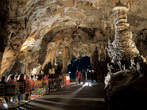
The River Krka springs in the Krka Cave in the 268 height above see level and then it flows into the river Sava at Brezice. To the spring you can come after the pleasant walk throug the village Gradicek. The Karst spring is under the rock, where is the the entrance to the original Krka Cave. The examination of the cave is possible only with the tourist guide, which will accept you before entering to the cave. The cave is open from April to October. For the public was opened by the Tourist association Krka in the year 1996. The Krka Cave is 200 metres long and wide about 30 metres. The chamber is concluded with the 30 metres long siphon lake. The siphon goes after the 210 metres into the spacious, 60 metres long final cave. The common length of the researched tunnels is about 490 metres. It is the horizontal cave, from which vomits the underworld water only by overflowing. The floors are covered with large boulders and rubble, which are in the eastern part piled up all to the stamp. In the cave is the constant inhabitant the human fish. The Krka Cave was sometimes the shelter for the local people. About that wrote Josip Jurcic in his novel Jurij Kozjak. The first one, who put down the visit of the Krka Cave, was Janez Vajkard Valvasor in the second part of the 17th century. The first plan of the Krka Cave was made in the year 1887 by V. Hrasky. The main entrance was wide open in the year 1937, so that they could made possible the faster outflow of the underworld water and so save the problem with the floods in Radenska field. The cave divers have only in the year 1995 swam across the labyrinth of the underwater tunnels and broke through the final Vrhoved chamber. River Krka is the longest and completely Slovenian river. It has 94 kilometres of surface stream and rainy – snowy regime with the highest water in autumn and the lowest in summer. It’s river basin is extended over the 2284 square kilometres. Krka River is the only tufa producing river. Its water is saturated with the limestone, which from the village Marinca to Otocec eliminates like tufa and forms the characteristic barriers and thresholds. In the past there were numerous mills and saws, but today is prevailing more the recreative and tourist meaning of the river. Particulary is attractive for kayaking and fishing. Because of the pollution waters in the Karst hinterland is the Krka River already by the source ranged to the second quality rank. Its quality goes worse in the middle and lower stream, where is in the second and third rank. Above the village Gradicek is located the Poltarica Cave, the neighbour of the Krka Cave, which was uncovered in the year 2003. The cave is above the source of Poltarica, the first afflux of the Krka River. It is ornamented with many stalactites, curtains, tubes, five siphon lakes, human fishes and rapids. Poltarica Cave is not open for tourists, but you can see it in the attendance of the cavers.
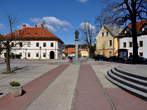
Kamnik is one of the oldest towns in Slovenia. It is an administrative, cultural, tourist and industrial centre on the southern slopes of the Kamnik Alps. It has a partially preserved medieval core to the city. It was the most influential town of the Carniola country in the 12th century, however, it was comquered by Ljubljana in 13th century. Through centuries there were home of smithery, nailery, leathery and furriery. Two raised areas above the city remind us of the town’s older periods. Mali grad (Small castle) is only a few meters above the town’s core. The Andeski Counts built the castle in the 12th century. Today it is only possible to see the castle walls. In a better condition is the castle’s chapel with its Roman porch on two levels – the upper for the gentry and the lower for servents. Stari grad (Old castle) is on a steep hill 180 meters above the city. There are ruins here of the castle from the 13th century. Today there is restaurant near the ruins with an access road. In the city is the cemetery of the old city walls with its defence tower. On the slopes of the Tunjice hills above old city core you can find the Renaissance Mansion (castle) Zaprice from the 16th century. Today there is a museum there. In the city you can find a Franciscan monastery dating from the 15th century with an interesting preserved library. The Constitutive part of Kamnik is also Mekinje with its monastery dating from the 14th century. The main street in Kamnik is Sutna. At the Agency for tourism and business you can book a visit to Kamnik and its environs but you need to make a request in advance.
Polhov Gradec is a village, which belongs to the Dobrova – Polhov Gradec Municipality. It lies in the shelter of Polhograjska Gora and Old Castle or Calvary. Most famous sights are Polhov Gradec Mansion and the Church of the Birth of Mary, which give the village the picturesque image. In the Polhov Gradec Mansion is a local museum and there are places for romantic weddings, which are also organized in the Mansion Park. In the nearness of the mansion is a Home of Beekepers, where we can buy honey and different products from it. The Church of the Birth of Mary was built in the baroque style. Polhov Gradec was settled already in the Roman times and the most beautiful objects from that time are bronze jug and Celtic fibula, which can be seen in the museum. The most prominent villager was count Rihard Ursini Blagaj, who was also the first mayor in Polhov Gradec. In the old village centre are the most interesting houses Sever house with the preserved black kitchen, Ostetar house, house pri Peku, Faci house and others, which preserved signs from the past. We can strengthen and relax in the inn Gostilna pri Pratkarju or in the inn Pograjski dom. The surrounding offers lots of possibilities for shorter and longer trips. We can go by the Path of Count Blagaj, which begins by the complex of Polhov Gradec Mansion, to the Calvary, to Polhograjska gora – Lovrenc (824 m) and other.
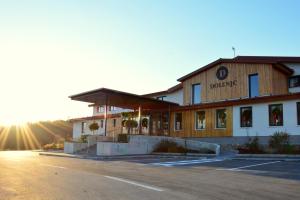
Trojane is a small village that belongs to the Municipality Lukovica. It is situated by the main road Ljubljana – Celje. Trojane is famous by its restaurant, where they make and sell well known Trojane doughnut, which are also registered trademark. The restaurant consists of several buildings, which have a different purpose. In the old restaurant from the year 1849 is tradition wonderfully interwined with modernity. Guests can use several different large rooms. The newest restaurant is more suitable for larger groups and also has a semicircular glassy terrace from where is a nice view to surrounding area. Besides doughnuts and daily lunches guests can enjoy a la carte dishes, pizzas, vegetarian dishes, bottled wines and many other. In the nearness are also the market store and shop for doughnuts and other sweets. There is available 130 parking places for cars.
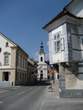
Vrhnika is a town, which is a centre of Municipality of Vrhnika. It is located by the old road from Ljubljana to Postojna. It lies on the slopes of Pokojnik plateau and on the western side of Ljubljansko swamp. The beginning and development of the city is connected with ships and traffic on the Ljubljanica River, which springs here on several places. Vrhnika is also situated on area, where is the shortest passage from Ljubljana basin over the karst and Inner Carniola forest plateau to the sea. The place of today's Vrhnika was already settled before the arrival of Romans. In written sources is first mentioned in 1300 and at that time was named Upper Ljubljana.
In the city we can see the following major attractions: the monument of greatest Slovenian dramatist, poet and writer Ivan Cankar (1876-1918), the birthplace of Ivan Cankar, Lavrencic House – the Old Post Office, a former Hotel by Black eagle, the Church of Saint Lenart, the Church of the Holy Trinity, the Church of St. Paul on the Hill and other.
The birthplace of Ivan Cankar is separated into a black kitchen, living room and chamber. It was proclaimed for a cultural monument. Lavrencic House belongs between the most important and oldest buildings in Vrhnika. It is located on the bank of the Ljubljanica River, where was sometimes a passanger port. A Hotel By Black eagle was built in 1850. By the Church of St. Lenart are buried Ivan Cankar's parents. The Baroque style church got in the 18th Century. It was built around 1640. The Church of Saint Paul is located on the place of the former Roman camp and was built in 1851.
 KRAJI - Slovenia
 BovecBoutique Hotel Dobra Vila Bovec