Source: Public information of Slovenia,
The Surveying and Mapping Authority of the Republic of Slovenia,
State map in measure 1 : 1.000.000, 1995
www.gu.gov.si
Recommended
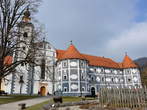
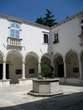
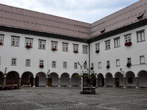
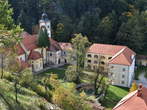
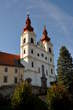
The Carthusian Monastery Bistra is situated in Vrhnika Commune in the southwestern border of the Ljubljana swamp. The beginnings of the monastery go to the year 1220, when the Carinthia duke Bernard Spanheimski invited to Kranjska the first Carthusian monks. Bistra was one of the fourth Carthusian Monasteries in Slovenia. Beside Bistra were also Zicka Carthusian, Pleterje Carthusian and Jurkloster Carthusian. Bistra reached its highest point in the economical and cultural development in the 14th century. The monastery was through centuries many times affected from earthquakes and fires. From the medieval plan was only preserved the small part of the Gothic cloisters from the year 1449. The kernel of the building was the one nave church from the 13th century, which was demolished in the year 1808. It was standing in the place where the courtyard opens today to the park. The Chapel of Saint Joseph, which is decorated with frescos and stuccoes of Anton Cebe from the 18th century is located by the present baroque crossing to the inner yard. By the brook were in the 16th century built the farm buildings. The monastery was in the 17th century renovated and added the baroque arcades. The Hapsburg emperor Joseph II. in the year 1782 published the decree about dissolving of the monasteries. The monks had to left the monastery and with the property managed the state. In the year 1826 bought the buildings and the surrounding property the manufacturer and merchant Franc Galle. He changed the monastery to the manor house. The manor house was afther the second world war with all the property nationalized. Technical Museum of Slovenia is in the Cahteau Bistra from the year 1951.
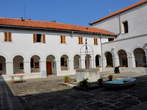
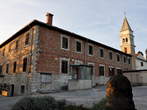
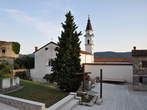
Sticna Abbey is situated among Dolenjska hills. Among the rare working cloisters is the only one, which belongs to Cistercian monks. The Cistercian order originates to the year 1098 to Burgundija in France. It got the name by the place called Citeaux. The founders were three saints, which were the benedictine monks from the monastery in Molesme. The Sticna Abbey is today the important cultural and religious memorial. It was established from the patriarch Peregrin I. At that time it also got lots of property. The monks Cistercians have beside prayers dedicated lots of their time to charity, work and economical activity. From the 13th century they also work on pastoral soul. In the second part of the 15th century had experienced many attacks from Turks and had crisis in the 16th century. The new blossoming was in the 17th century. That lasted till its disbandment in the year 1784. The abbey was again inhabited in the year 1898. It is the oldest in the Slovenian territory. In Sticna Abbey lived well-known Slovenian medical man Simon Asic. Here were also educated Anton Tomaz Linhart and Jakob Petelin Gallus. The complex of the abbey is composed from the Romanic cloistral church – basilica, which was in baroque twice renovated, early Gothic cross – shaped corridor with frescoes and the line of the buildings with the change from the 17th and 18th century. In the first floor are museum and gallery collections from the Slovenian religious museum. Part of the garden in the walls at the southern side comprehends meditative park, which is completely distant from the other areas and ordered like the peaceful, green grass. In the shop you can buy well – known herbs of the Simon Asic and products of other monks.
Other
The St. Cecilia's Church and Capuchin monastery are situated on the right bank of the river Savinja. They lie on the smaller hill and the easiest way to access them is by 90 covered stairs. Stairs were made in the year 1826 and renovated in the year 1972. From here is a nice view to the old town centre and to the park on the left bank of the river Savinja. Capuchin monks belong among the youngest branch of the Saint Francis of Assisi, the patron of merchants and animals. They had the greatest blossoming in the 18th century. The Capuchin monasteries in Slovenia are in Celje, Maribor, Ptuj, Krsko, Kancevce, Vipavski Kriz and Skofja Loka. The Church of Saint Cecilija was consecrated in the year 1615. This can be seen inside on the stony board, where it used to be prayer choir in the past. The Capuchin monastery was the permanent seat of the theological and philosophical studies. During Second World War was changed into prisons by Germans. After the war the communist authority banished the Capuchin monks and dispossessed the monastery. St. Cecilia's Church and Capuchin monastery became the seat of the new parish in the year 1960. From the monastery we can go to Miklavski hrib or Heracles Temple or we can walk to the City Park in Celje.
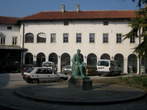
Kidric Street in the Old Town of Koper is littered with many interesting buildings such as the Church of the Holy Trinity, Saint Nicholas Church, Tacco Palace, House with a wooden balcony, Servite Monastery and Totto ex Gavardo Palace. The church of St. Nicholas was built in 1594. It was attended mainly by sailors with families, to whom St. Nicholas the patron saint was. Inside the church we can see a one-nave space with large canvases of Venetian painters from the first half of the 17th century. The former Servite Monastery was founded in 1453. In the 19th century it housed a public hospital and, after the end of Second World War, a provincial hospital. Since 1996, the building has been abandoned and left to decay. Its renovation is being delivered by the facility managers, which are the Ministry of Higher Education, Science and Technology and the University of Primorska. The Belgramoni Tacco Palace from the early 17th century is an example of beautiful baroque bourgeois architecture.
Lent is a beautiful old part of Maribor along the Drava River. It is the oldest part of the city that becomes most vibrant in the summer when the international multicultural Festival Lent takes place.
The Drava embankment is full of top cultural events and entertainment at that time. Numerous cafes, bars and restaurants invite you to sit down with excellent hospitality. The most important sights on Lent are the Water Tower, the Jewish Tower, the Old Bridge, the Old Vine and the Old Vine House, Manor Zicki Dvor, the Minorite Monastery, the Minorite Church of Mary's Assumption, the Judgement Tower, the city walls of the Old Town Center, and Market hall on Vodnikov trg. Lent used to be an important port, with about 1000 river timber rafts landing annually. Even today, you can try your hand at riding on a traditional raft. Lent started to be renovated in the 1980s. The biggest pride of Maribor is the Old Vine, which is the oldest noble vine in the world. It is more than 400 years old and can also be found in the famous Guinness Book of Records. The Old Vine winds its way along the south facade of the Old Vine House, which is a tourist information center, exhibition and event place.
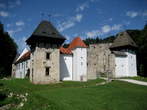
The Water Tower dates from the 16th century. It is built of stone massive walls with firing lines and represents a Renaissance fort. The Usnjarska ulica Street, one of the oldest in Maribor, passes by. Until the end of the 14th century, the Manor Zicki Dvor was the property of the Carthusian monastery of Zice. At the beginning of the 19th century, it was transformed into a barracks with the Minorite monastery, and later into military prisons and a court. The Jewish tower is located next to the synagogue in Jewish Square. In it today has the premises the Fotoklub Maribor. The Judgement Tower is also one of the defensive towers of the town walls that protected the city. It delivered judgments, they also associate it with witchcraft processes. The Minorite Church of Mary's Assumption forms the central part of the Minorite Monastery, which is the only medieval monastery in the city. The church was given its present appearance with a baroque tower and facade in the 18th century.
Today's Old Bridge was built between 1906 and 1912. You can buy all kinds of agricultural products (dried fruits, seeds, herbs, dried goods, fruits, vegetables, meat, etc.) at the renovated modern marketplace on Vodnikov trg Square.
Piran is a beautiful seaside town that attracts many visitors throughout the year. In Bolniska Street you can see the Minorite monastery of St. Francis, Minorite Church of St. Francis, Church of Mary of the Snow, Gallery Marko Jezernik and many other interesting buildings.
The monastery of Saint Francis was founded around 1301. The original monastery was built in the Gothic style and on the ground floor. The monastery was then enlarged and renovated in the 17th and 18th centuries. In it, the Minorite brothers performed their mission until 1954, when it was nationalized. In 1996, it was returned to brothers by denationalization, who immediately began its restoration. The restoration returned to the monastery spatial harmony, architectural harmony and original purpose. The Monastery Cross is one of the most acoustic venues in Slovenia. During the summer, many music events take place here. Exterior of the Church of St. Francis dates from the 19th century and the interior dates from the 17th century. In front of the church is a smaller square where used to be a cemetery. The Church of Mary of the Snow was first mentioned in 1404. In the presbytery you can see the baroque altar from the 17th century.
On the east side above the entrance, the main picture shows the miracle of snow. It dates back to the second half of the 17th century. Pictures of the Crucifixion and the Annunciation were discovered on the tribal wall in 1969.
Minorite Square was named the Beef Square in the Middle Ages, because they leaded the cattle to the River Drava from here. From the year 1959, when it was built the new bridge over the river, goes from here to the town one of the main roads. On the Minorite Square is the Mary’s Pillar, which was erected by the count Georg Friedrich Sauer in the thanks for the victory above Turks. After many famous victories they erected such columns in many towns of the Hapsburgs monarchy. The founders of the Minorite Monastery were the well known Lords of Ptuj, which already established the Dominican Monastery in the year 1230. The earliest mentioning of the monastery in written sources goes to the 13th century. In this time the buildings were comprehending only the eastern part of the today’s building. They rebuilt it many times from the 14 th century. They changed the monastery and the church to the baroque style in the last quarter of the 17th century under the guidance of the guardian Gaspar Dietel. The church was pulled down by the bombs in the year 1945. On the place of the former church by the Gothic presbytery they built the post office in the year 1967. The presbytery was finally renovated in the year 1989. They demolished the post building in the year 2001 and started to built the church nave by the plans of the former church. The most beautiful rooms are the library and the refectory.
On the side of an old chapel the first church was built between 1636 and 1643. A bell from 1666, the bell-tower and a part of the nave, now exhibited in the presbytery, are the only remains of the original church. In 1663 the church was taken over by the Augustinian friars from Radgona. With the help of castellan Traumansdorf from Negova they had a monastery built along the southern part of the church which was in its turn aggrandized. The church had soon become too small to accommodate the increasing number of pilgrims.
In 1735 the count Draskovic's financial help facilitated the building of a new Baroque church. In 1756 the main altar was completed and as many as six side altars three years later. The new church was consecrated in the year 1772. Both bell-towers at the church frontage and facing the square were built in years from 1779 to 1780. At the same period the church was connected to the cloister. In 1787 the monastery was closed down while the church became a parish under the patronage of deanery in Lenart. In 1811 the Augustinians abandoned the monastery and the church was taken care of by diocesan priests. In 1854 the parish passed to Franciscan friars who are still responsible for it. In 1885 the bell-tower near the main altar got its present appearance.
The church in itself is considered a Baroque masterpiece. A quite special artefact is the main altar made between 1752 and 1756. It belongs among three biggest altars in Slovenian churches. The magnificent Baroque altar is very dynamic due to statues and angel's figures, impressive pillars as well as a picture which represents the Mystery of the Holy Trinity. In 1883 and 1884 the church was painted by Oswald and Egid Bieri and Giacomo Brollo. The third altar was made by Josef Straub in 1756. A Loretto chapel was built in 1693 lean-to the first church and contains a statue of Black Mary. A column bears a famous Mary's throne and a statue of the Virgin which used to be carried around in processions. The cloister houses a church museum and a famous library with more than 3,000 precious volumes. Among the books can be found the first printed book on physics from the year 1574. Since 2003 the church has one of the biggest organs in Slovenia.
 KRAJI - Slovenia
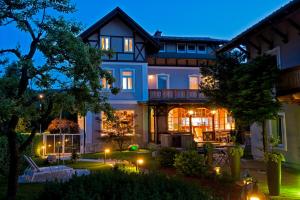 BledVila Alice Bled - Adults only