Source: Public information of Slovenia,
The Surveying and Mapping Authority of the Republic of Slovenia,
State map in measure 1 : 1.000.000, 1995
www.gu.gov.si
Recommended
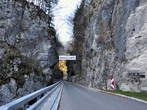
The Mostnica Gorge is situated in the Alpine valley Voje, which lies northeast of the Lake Bohinj near the village Stara Fuzina. The river beds are approximately two kilometre long gorge, which was excavated by the brook Mostnica. The Mostnica Gorge is on some places very narrow, only one metre. The most deep is by the Devil's Bridge, about 20 metres. The Devil's Bridge was built in the year 1777 by baron Ziga Zois for easier supply with charcoal and iron ore from nearby hills. The bridge from carved stone is remarkable constructional work, because it was built in one arch above the steep gorge of the brook Mostnica. The most interesting things in the Mostnica Gorge are the rock in the shape of the small elephant and the many bridges. For the entrance to the gorge we have to pay the entrance fee in the summer time. The path goes by both sides of the gorge, so we can do the round trip.
The Vintgar Gorge is situated in the road from the Bled over Spodnje Gorje, Podhom and the small village Vintgar. We can park car before the gorge, there is a big parking place. The Blejski Vintgar Gorge is open from the end of the April till the end of October but it depends on the weather situation. The gorge is open from eight to seven in the afternoon. It was discovered in the year 1891 by photograph Benedikt Lergetporer and Jakob Žumer, mayor of Gorje village and cartographer. For tourist visit the gorge was open in the year 1893. The paths were from that time frequently renovated. The Vintgar Gorge is 1,6 kilometres long. Through the gorge flows the wonderful greenish Radovna River with the pools, waterfalls, rapids and roaring, which is echoing over the narrow passages. The height of the slope is 250 metres. In some places is protected with the nets. The path leads us across the wooden bridges and so called Zumer gallery. Necessary is to have good sport shoes, because in some places is the path slippery and dangerous. The river beds crosses the railway line Jesenice – Most na Soci. At the end we can see the powerful Sum Waterfall, about 15 metres high, which is one of the rare Slovenian river waterfalls. Here is also the barrage for the hydroelectric station Vintgar. We can refresh and recover at the beginning of the gorge or at the waterfall Sum. In both places are small cafes. We can go back at the same way or over the Hom to Sveta Katarina, where is a historical church and wonderful view to Karavanke and Bled with surroundings. For walking and return with photographing and viewing we need about one hour and half. The Vintgar Gorge is exceptional beautiful and worth seeing. In summer months is pleasantly cool.
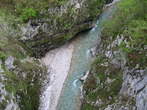
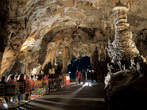
Tolmin is the central point of the Tolmin landscape. It is situated on the balcony between rivers Tolminka and Soca. The city was between first world war, when in the nearness were taking place Soca fronts, very much demolished. In this place are the most remarkable river beds of Tolminka and Zadlascica. Tolmin river beds are the most southern entrance point to Triglav National Park, which is the only Slovenian national park. The road goes from Tolmin and one kilometre to Zatolmin. Tolmin gorge is the most important natural remarkableness. Tourist paths were built from the years 1953 to 1958. They go along Tolminka to the thermal spring and by Zadlascica to Bear’s Head. The main keeper of the road is the Tourist association Tolmin. On the entrance point visitors can buy admission ticket, receive the map of the road and all other important information. The circular trail goes to the confluence Zadlascica and Tolminka, from there to Bear’s Head, by the road Zatolmin – Cadrg to the entrance into Dante’s or Zadlaska Cave. The cave is named by the village Zadlaz. The other name got by the poet Dante Alighieri who perhaps in the beginning of the 14th century visited the cave and in this environment found the inspiration for The Hell in his poem Divine comedy. The Bear's Head is called the natural bridge, the large rock, which had over the centuries wedged between the walls of the canyon Zadlascica. You can return by the road and go across the Devil's Bridge, which was built in the year 1907. At the beginning was wooden, but later was exchanged with iron construction. From this place is a beautiful view to the Tolmin gorge, which was through the centuries shaped by the river Tolminka.
Other
Gorge Dovzan is situated north from town Trzic. Torrential river Trziska Bistrica excavate it to old earthly stratum. River flows over cascade of immense rounded blocks white flintstone conglomerate. Gorge Dovzan is one of central points in Slovenian geological transverzal. It is protected as natural monument because of its unique location of remains fossilizied life plants and animals in stoneware old earthly century Palaeozoic. The oldest and the biggest founded samples of fossils are old around 270 million years. In this place were first founded and described numerous species of special fossils. Particularity of Gorge Dovzan is road tunnel and five pyramidal limy towers, Kušperg formations, where is also settled climbing. In the year 1979 were climbed first free scaled directions, here have begun first directions of ninth level. Through Gorge Dovzan are leaded forest way, geological way, mountain way, way to partisan printing office and belvedere way. In village Cadovlje stands Jemenšnik house, which was built in the year 1766. It is unique example of Karavanken architecture.
Krcnik Troughs are located above Kotline under the village Kozbano. The brook Kozbanjcek carved into the limestone very picturesque and interesting beds, which are long about 40 meters, deep to 6 meters and wide from 0,5 to 6 meters.
Under the first bed we can see the scenic natural bridge Krcnik, which is smooth and well rouned, because it was created by grinding water. The arch of the natural bridge is about 1 meter wide and 5 meters long. In Slovenia these bridges are only few and they are mostly more edged, because they were made with mouldering of rocks. Krcnik Troughs then continue with a narrow channel and in the end they open to the gorge with steep walls, which runs out to the narrow valley. The natural bridge Krcnik belongs to the most beautiful bridges in Slovenia.
The nearest Kotline are three pools, which were made by the stream of brook Kozbanjcek overcoming the 10 metres high rocky walls. Here is in the summer time popular natural baths for young people. Krcnik Troughs with the bridge and Kotline are from the year 1985 protected as a natural monument.
Mlinarica Gorge is situated in a wonderful valley of Soca, which belongs to the Bovec Commune. Mlinarica Gorge lies hidden between mountains Prisojnik and Razor. With its ski slopes supplies stormy brook Mlinarica, which is fettered between rocks of Kukla mountain and is almost unseen when it flows out to Soca river. Brook has excavated one kilometer long and 100 metres deep gorge, which is narrowed in unique water channel before confluence with the river Soca. The narrowest parts are wide only one meter. In the severals parts are wedged in rocks, which forms natural bridges. Brook Mlinarica has considerable fall, from 300 metres to 700 metres length, which forms 8 metres high waterfall. In inner, without any special equipment pathless part of the water channel is even more waterfalls and pools. Because of the rocky depression is visit of Mlinarica Gorge possible only to the entrance in the valley. In the nearness is to be found spring of Soca river and Alpine botanical garden Juliana, which is the oldest botanical garden in Slovenia.
The Pokljuka Gorge is one of the most beautiful gorges in Slovenia. Now is possible to visit gorge only in your own responsibility, because everywhere lies the remains of trees and branches. In spring time is also dangerous because of falling stones. Some parts of the Pokljuka Ravine are ruined. It is accessible from the road of Bled, over villages Zgornje Gorje, Krnica and also from Zatrnik. It belongs to Triglav National Park. It is 2 kilometres long and 40 metres deep. It was made from flowing water of Pokljuka glacier. The remain is today brook Ribščica, affluent of river Radovna. You can see here beautiful natural bridge, Pokljuka hole and Side gorge. Pokljuka hole is the cave hall with two entrances and three natural windows. Through the upper entrance leads the way to the Old Pokljuka. Side gorge gets in rainy days 22 metres long waterfall. Great natural bridge is situated 24 metres above ground. People call round and narrow plateau kindergarten. Through the narrowest gorge to the most beautiful kinderkarten and smaller bridge is possible to go on to the wooden bridges – galleries, but they are unfortunately destroyed now. The wooden bridges, which were built in the year 1930 by members of Tourist society of Gorje, are called The Galleries of prince Andrej. The Pokljuka Gorge is at ground and at rock walls covered with a different kind of plants, like fern, forest flower and mountain flower. In summer time the gorge offers kind refresing and special experience.
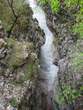
The Pekel Gorge is situated near the village Borovnica. From Ljubljana is about 23 kilometres away. It was made with the sank of the Ljubljana swamp. The Pekel Gorge was excavated by the Otavscica brook. In summer months is here pleasant and refreshing coolness. Before the beginning of the road is the information table about the Pekel Gorge. In the gorge you can see five waterfalls, which are in the winter time also suitable for climbing. Access to them is in some regions difficult because of the steep slope and because of that is necessary bigger caution. The first waterfall is the smallest and it is 5 metres high. The other four waterfalls are high from 15 to 20 metres. The fifth waterfall is the higher and they say the fourth waterfall is the most beautiful. The third waterfall is called Kozak because of the silhouette of the chamois in the rock beside the waterfall. The gorge has beside the foaming and wild water also wonderful animal and vegetal world. The symbol of the gorge is the Slovenian endemical plant the Carniolan Primula. Slovene name is Kranjski jeglic and latin name is Primula carniolica. It has beautiful red and violet blossoms. The plant blooms in April and May. The first one, who made footpaths in the gorge, were people who did the char wood and people who did not have their woods for firewood. Under and above the Pekel Gorge were saws and mills. In the glade before gorge is the Brancelj-Kosir mill, which was renovated in years from 1994 to 1995 by the members of the Tourist association Borovnica. Close to the parking place is the restaurant Pekel, which is famous by delicious home made food, especially by trout.
 KRAJI - Slovenia
 MariborGuest House Pikapolonca