Source: Public information of Slovenia,
The Surveying and Mapping Authority of the Republic of Slovenia,
State map in measure 1 : 1.000.000, 1995
www.gu.gov.si
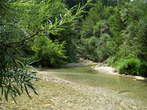
The Rinza River is the only river in the Kocevje region beside the bordering Kolpa river. It is clearly a karst river. The Rinza River has many springs and the biggest one near the village of Mrtvice is called Reberski studenec. After a short flow on the surface it disappears underground at the end of the Kocevje Plains. In the old times the river flowing through Kocevje represented a defence ditch surrounding the castle with the town centre, creating an island. After the threads of invasion were over the ditch was filled up and nowadays the Rinza River forms a bend around the old town centre. The river was kept on surface with the help of dams. In the period of industrialisation there were many sawmills and mills operating along it. Today is polluted as the town's sewer system still partially flows into it.
The Drava River runs through Maribor, which played an important role throughout the city’s earlier history. The formation of the city was closely linked to its passage. The Old Bridge, the Koroska Bridge, Tito Bridge and Studenci Footbridge run across the Drava River.
The Old Bridge was the cause of various dangers in wartime and a source of income in peacetime. It was built between 1906 and 1912. It is one of the most beautiful bridges in Austria-Hungary. The Koroska bridge was built in 1996. It connects the left side of the town with the Studenci district. Near the Koroska bridge is the church of Saint Joseph. Tito's bridge was built in 1963 and is named after Yugoslav President Josip Broz Tito. From Tito's Bridge there is a beautiful view of the Church of Saint Magdalena and Pohorje. Today there are many walking trails along the river. The Europark Shopping Center was established near the Old Town. Lent is the oldest part of town along the Drava embankment, where you will find numerous bars and restaurants. The Lent Festival is held here every year. Near Lent is located the Pristan Bath.
The Studenci footbridge has a very colorful history. It was blown up during Second World War and was swept away in 1946 by the rising Drava River. The new one was erected in 1948 and in 2007 its reconstruction began. The official opening was in January 2008.
Near the stone bridge and John the Baptist's Church is the confluence of Jezernica and Mostnica, which merge in the Sava Bohinjka river. Jezernica is the second shortest river in Slovenia. The stream of the Sava Bohinjka river begins in the valley of the Triglav lakes, which is one of the most beautiful valleys in the Julian Alps. Each of the seven lakes is named after its characteristics. The lakes are situated between 1319 and 2002 meters height above sea level.
The river then continues the way as the Savica Waterfall and flows as Savica river into the Lake Bohinj. From the lake flows as Jezernica.
Mostnica is the alpine brook, which rises in the Voje Valley as the Mostnica waterfall or Voje waterfall. In the village Stara Fuzina flows to Mostnica the brook Ribnica and after about one kilometre of common stream they fall into the Sava Bohinjka.
Sava Bohinjka is one of the most beautiful and clean rivers in Slovenia. Beside different sport activities is known as the fishing area. Sava Bohinjka continues its flow to Radovljica, where it unites with Sava Dolinka to the longest Slovenian river Sava.
Conflucence of Sava and Krka is situated between the village Catez ob Savi and the city Brezice. Bridge is a popular point for photographers and lovers of the nature. The Brezice valley with the rivers and affluents belongs between the most important hydrographic region in Slovenia. Rivers played an important rule in the life of the inhabitants. The only source of the income was for many families trading with fishes. By rivers they built knittings of drawing ropes, harbours and shipyards. At the same time they started to built rests and restaurants for rafters. River was the only traffic road for rafting trade until it was buit the first railway line.
Tolmin lies at the prominence of the rivers Tolminka and Soca. It is the natural centre of the Tolmin landscape. The confluence of Tolminka and Soca is located about 100 metres of the city Tolmin. The confluence is well known meeting place for young people, popular walking point for local people, concert place and many other. In the wooden cottage is a bar, where you can get juice or beer and enjoy in wonderful views to the emerald river Soca. In summer months are here organized famous festivals like Soca Reggae Riversplash, Metal Camp and creative camp Sajeta. They have workrooms, concerts and projections of films. At the confluence you can see the deserted building of the former Casino Paradiso. In the nearness is the purifying plant and interesting hanging bridge.
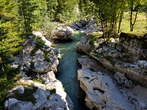
The confluence of Tolminka and Zadlascica is located in the nearness of the most narrow part of the Tolmin Gorge. You can go to the confluence from the entrance cottage, where you can buy tickets. You will walk first by the foothpath, which goes through the wood and then you go over the stairs against the footbridge over Tolminka. In this part you can see the confluence of Tolminka and Zadlascica. Also you can see the confluence from the footbridge over Zadlascica, to which you can come, if you go over the bridge of Tolminka and then in the left direction to Thermal Spring. The confluence is the most lower part of the Triglav National Park. It is situated in about 180 metres height about sea level. It is the only confluence in the water channel in the Slovenia area. The wild water channels with the typical breakings, which are seen like the smooth vertical rocks, have been done with the engraving of Tolminka to the limestone. You can see the similar in Julian Alps only in the gorge Mlinarica in Trenta. The Zadlascica River had excavated water channels with the depth erosion. When the narrow passages of both channels are divided, the rivers are united.
 KRAJI - Slovenia
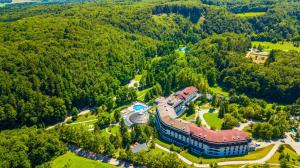 Smarjeske TopliceHotel Toplice - Terme Krka