Source: Public information of Slovenia,
The Surveying and Mapping Authority of the Republic of Slovenia,
State map in measure 1 : 1.000.000, 1995
www.gu.gov.si
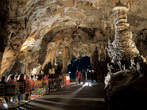
Velika Planina is the high mountain plateau located in the foothills of the Kamnik-Savinja Alps, where the best preserved herdsmen settlement in Europe is located. The fastest and most common access is by cable car from Kamniska Bistrica, where parking is located. When you arrive at the top, it is possible to us a chair lift that will convey you to the Gradisce. A little further on, one can see the wonderful view of the herdsman settlement. On the other side are the high mountain peaks of Grintavec, Skuta, Brana, Ojstrica, Planjava, Lucka Baba, and Kamnik saddle. There are about 140 cottages on the plateau, all designed by the architect Vlast Kopac. Rich alpine flora and grassy slopes, Carst sinkholes, larches and pine trees create a fairytale landscape, perfect for an all-day trip. One can rest by the Chapel of Marija Snezna, or one can choose to walk down to the cave of Vetrnica that is accessible by a circular path. There are, in fact, two caves: Mala (small) and Velika (big) Vetrnica that are connected by a natural bridge. The caves are the result of a high alpine environment where snow is still to be found even in the summer months. On the western border of the plateau (Zeleni rob) lies the picturesque natural window Luknja. There a also a few mountain huts on the plateau: Domzalski dom, Dom na Mali planini, and Domzalski dom Mountain Hut. In winter, there is a ski slope that offers good skiing and winter beauty.
Ljubljana is a vibrant and modern capital of Slovenia, one of the largest cities in Europe. It has been the capital of the Republic of Slovenia since 1991, when Slovenia became an independent state.
The symbol of Ljubljana is represented by the Ljubljana dragon, which is visible on the Dragon Bridge and in the coat of arms. Throughout its diverse history, the city has been influenced by several different cultures, since it was located at the crossroads of Romance, Germanic and Slavic nations with their customs, customs and languages. Today, Ljubljana is the cultural, geographical, economic, scientific, administrative and political center of Slovenia. The highest state bodies, the Parliament of the Republic of Slovenia, the President of the State, the Supreme and Constitutional Courts, the Government and a number of consulates and embassies operate in Ljubljana.
There are many primary and secondary schools and a university in the city. The center of cultural events are Cankarjev dom, Slovenian Philharmonic, Opera and Ballet theaters, SNG Drama, galleries and museums. National and University libraries stand out among the libraries. The biggest attractions in the old town are the Ljubljana Castle, which is a recognizable building by far, Franciscan Church, Triple Bridge, City Hall, Robb's Fountain, St. Nicholas Church and many more. Since 2006, Ljubljana Castle has been connected to the old town by a funicular. Famous Slovene architect Jože Plečnik left a great mark on urban architecture between the two wars.
The picturesque Ljubljanica River, which winds through the city, crosses many bridges, the most famous being the Dragon Bridge and the Triple Bridge. The hustle and bustle of the capital is mitigated by many smaller city parks, large green spaces such as Tivoli Park and the location between forested areas. Ljubljana also has the Ljubljana Zoo, which was founded in 1949 and the interesting Ljubljana Botanical Garden, which has been operating since 1810. By setting up a sports hall in Tivoli and a modern Stozice Center, which covers a multi-purpose sports hall and a football stadium, Ljubljana has become an internationally renowned sports center.
Outside the city center there is a larger shopping, sports, entertainment and business center - BTC City. Popular excursion points for Ljubljana residents in the city and the surrounding area are Sisenski hrib, Katarina, Tosko celo, Rasica and Smarna gora.
Piran is an old port town in Slovenian Istra. The town is bilingual, Italian and Slovenian. The Italian name for the city is Pirano. It is situated at the cape of the Piran peninsula. Piran has kept its medieval appearance with narrow streets and closely built houses, which gives it a typical Mediterranean character and a special charm.
On a hill above the houses, the church of Saint George is situated, with a high tower and an interior with many paintings and intricate artwork. Piran has been settled since before Roman times. In the years between 1909 and 1953, Piran was connected with Portorož and Lucija by an electric railway. Today, Piran is an administrative and tourist center which attracts both local and foreign visitors. Some of the most fascinating sites in Piran include the Tartini Square, the Town Palace, the Tartini Monument, the Tartini House, special stone columns for flags, the Court Palace, the May 1 Square, also known as the Old Square, and the old town wall composed of three walls from different time periods. In the city center is the Aquarium which was established in 1964. The Promenade extends along the coast and offers many restaurants with a wide variety of local foods and drinks. Church of Saint George offers an extraordinary view of the old town and the Gulf of Trieste. It was built in 1638 on the site of the Romanesque basilica and the Gothic three-nave church. A bell tower stands independently of the church. It was built in 1609 after the model of the bell tower of St. Mark in Venice. Tartini Square was originally a seafront for fishing boats. It was demolished in 1894. In the middle of the square stands a bronze monument to Giuseppe Tartini, a famous Piran countryman, composer, violinist and music educator. The Church of Our Lady of the Snows is located along Bolniska Street. It was built in 1404 and rebuilt in the baroque style in the 17th century. Opposite the church stands the church of Saint Franciscan monastery. The monastery cross corridor with a portal is a remarkable work from the 17th century.
Narrow streets in Piran make it impossible to drive cars, so there are parking places in front of the city. Piran, Seča and Portorož are connected by a regular local bus route. A newer part of the town developed outside the walls along the coast towards Portorož.
Bled is by far the country’s most popular destination. Thanks to its placid fairytale lake and the island in the middle, this small town is the top choice for travelers who want to spend relaxing holidays in Slovenia.
The castle is perched 120 meters on a craggy bluff on the northern shore. The first trace of human settlement dates from the Stone Age. Bled is today a modern resort with many hotels, private apartments, car parks and various local and foreign culinary delights. It is especially renowned for the delicious “kremsnita” (cream slices), a local sweet made of custard. Bled is also famous as a rowing and boat race center. It is the starting point for numerous trips and walks in the beautiful areas surrounding Bled, such as the Pokljuka Gorge, Vintgar, the waterfall under Iglica, the Pokljuka plateaux, and the Triglav National Park. There is a path that encircles the lake which only takes an hour and one-half. You can also take a carriage by the Festival Hall for a tour around the lake.
Visitors can visit the island with a typical “pletna” boat which is steered with only one oar and accommodates about 20 persons. The church on the island is famous for its “wishing bell” manufactured in 1543. If you make a secret wish, it will come true when you ring the bell.
Maribor is the center of Styria and the second largest city in Slovenia. It has a varied historical past. It was first mentioned as a town in 1254. A year later, the town began to build two kilometers long city walls that restricted the old city center.
The walls were further strengthened with defensive towers. In the Middle Ages, a Jewish community lived in Maribor, which built a synagogue. At the end of the 17th century, the city was affected by the plague, and at that time Maribor got one of the most beautiful cultural monuments in the city, the Plague sign. Beautiful church of Saint John the Baptist became the chair church in 1895. The construction of the railway from Vienna to Trieste in 1846 brought the city rapid industrial development. Due to the expansion of the city and with that the traffic, it was necessary to build new bridges that demolished the medieval design of the old part of town called Lent. The Drava River has been an important thoroughfare since Roman times. During First World War, General Rudolf Maister successfully defended the northern border and Maribor remained a Slovenian city. In Second World War, the city was almost demolished by air strikes allies and occupiers.
The consequences of the occupation behavior were visible for decades after the end of the war. After the war, the city experienced a rapid development. Maribor is today the economic, university, cultural, tourist and transport center of northeastern Slovenia. Maribor has many cultural and natural attractions, so it can take you all day to visit the city. Natural sights include: the Old Vine, Maribor Island, Three Ponds, Kalvarija, Piramida, Maribor Town Park, Studenski Forest, Drava, Pohorje, Stolni Vrh and others. Among the cultural sights are Maribor Castle, Cathedral Church, synagogue, water tower, court tower, Plague mark, Lent, Betnava Castle, Drava Bridge, Vetrinje mansion, Franciscan Church, National House and many others. Maribor with Pohorje, which fascinates nature lovers and adrenaline enthusiasts, offers an unforgettable experience on one hand and wine-growing hills on the other. Wine roads cross the slopes of Pohorje and the wine-growing hills and form a wine-cultural route.
Maribor is also an attractive place for shopping at Europark Maribor, where a number of renowned names are gathered, with an attractive range of global brands. The Habakuk Convention Center, however, is an ideal place for business and professional meetings.
Celje is the third largest city in Slovenia. The remains of a material culture histrically bear witness to wealthy and stormy centuries. In Roman times Celje was named Claudia Celeia and it was a rather strong and wealthy town. When people migrated, Celje was ruined. In the Middle Ages it is mentioned again in the year 1125, but its its unpredictable success reached its zenith in the 14th and 15th century. At that time Celje was under the authority of the Celje Counts and it would become the head town of the extensive Central European-Balkan region. Celje received its town rights in the 1451 from Friderik II Celjski. Celje has been subject to disasters and enemies alike, such as the Turks, but it still developed into one of the most important towns of lower Štajerska with vibrant shops and trade. In 1846 railway tracks brought industrialization. Celje is now a modern city pulsing with culture and tourism, a developed social life, a market and trade centre and with beautiful surroundings. Important cultural buildings are the Celje Home, the People's Loan Bank, the Town Wall, the Water tower, Maria's Sign, the Town Hall, the Court, Saint Daniel’s Church, the National Home, the Old County and others.
The Otocec Castle is situated near the city Novo mesto in Dolenjska. It is the only water castle in Slovenia and it stands on one of the island of the Krka River. Its image was formed through the centuries. The beginning of the castle goes back to the 13 th century, in the year 1252. The name Otocec originates from the Freizing bishops. The owners of the castle were named knights from the island – de Werde or islander. In the minddle of the 14 th century the building was widened and it got the ground plan of the letter L. The Castle Otocec was additional strengthened after the Turks devastation in the year 1471. In the second half of the 16 th century it got the renaissance appearance. In the second half of the 17 th century the castle building got among the other renovations also the arcade corridors in the ground floor and in the both floors of the southern tract. Between the Second World War the Castle Otocec was destroyed by fire from the partisans and in that time were ruined the precious archives in which was hidden some interesting stories from the rich history of this wonderful castle. After the war the castle was nationalized. Today is in the castle the Otocec Castle Hotel, which is very luxurious and a restaurant with the best culinary offer. Near the hotel, in the right side of the river Krka, is situated pleasant Camp Otocec. About 300 metres from the castle is the Sport Hotel and a motel, which is designed mainly for travellers in transit guests. We can get fun in the Sport Hotel, where they have gambling rooms. For business meetings is available congressional hall. At the weekends is possible to dance in the restaurant Tango at the sounds of the live music. The Otocec has also developed to sport centre, which offers excellent conditions for running or cycling and guests can play tennis, golf and other sports. The River Krka invites us in the upper current to rafting, under the castle you can go boating or fishing. The Hotel Otocec is the ideal place for romantic and unforgettable weddings, where guests can feel like kings. They offer arrangements like Castle wedding in Chivalric saloon, Castle wedding, Wedding in the open air, Romantic wedding in the shine of the torchs and candles, Wedding in the open air with bridesmaid and senior, Lords wedding and Wedding in the dreaming river Krka. In last years are very popular weddings in the open air under the tent in the Castle Otocec park. The park is shaped after the patterns of the English landscape style. The oldest trees are old almost hundred years and mayority was planted after the renovation of the castle in the 50 years of the 20th century.
Rogla is located on Pohorje, about 15 km from the village of Zrece, which is known mainly for Terme Zrece. Rogla is a natural climatic health resort and recreation center. Lovrenc Lakes, Klopni vrh, Lookout tower, Osankarica, Sumik and others are available for hiking enthusiasts.
They also have marked bike paths. In winter, Rogla turns into one of the most popular and visited ski resorts. Skiing pleasures are ensured by modern snowmaking systems from late autumn to early spring. There are 11 ski lifts, 2 chairlifts and kilometers of groomed trails for cross-country skiers on about 100 ha of groomed ski slopes. They offer storage, rental and service of ski equipment. From Thursday to Sunday, night skiing is possible at the Jasa and Košuta ski resorts. As part of the School of Snow Sports, Intersport Company organizes beginner and advanced skiing courses. In the Fun park Rogla there is a polygon for free style skiers and snowboarders. In Rogla, accommodation is possible in the Hotel Planja, Hotel Natura, bungalows, apartments, the Jelka Youth Hostel or in the Koca na Pesku Mountain Hut.
Hotel Planja offers guests a wellness center, a large multipurpose hall, seminar rooms, a children's corner, an aperitif bar, a gallery, an internet corner, an information point, a souvenir shop and a modern medico center with a pulmonology clinic. The wellness center has an indoor pool, whirlpool, saunas, children’s pool, massages and baths.
 KRAJI - Slovenia
 MariborGuest House Pikapolonca