Source: Public information of Slovenia,
The Surveying and Mapping Authority of the Republic of Slovenia,
State map in measure 1 : 1.000.000, 1995
www.gu.gov.si
Recommended
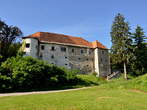
The Otocec Castle is situated near the city Novo mesto in Dolenjska. It is the only water castle in Slovenia and it stands on one of the island of the Krka River. Its image was formed through the centuries. The beginning of the castle goes back to the 13 th century, in the year 1252. The name Otocec originates from the Freizing bishops. The owners of the castle were named knights from the island – de Werde or islander. In the minddle of the 14 th century the building was widened and it got the ground plan of the letter L. The Castle Otocec was additional strengthened after the Turks devastation in the year 1471. In the second half of the 16 th century it got the renaissance appearance. In the second half of the 17 th century the castle building got among the other renovations also the arcade corridors in the ground floor and in the both floors of the southern tract. Between the Second World War the Castle Otocec was destroyed by fire from the partisans and in that time were ruined the precious archives in which was hidden some interesting stories from the rich history of this wonderful castle. After the war the castle was nationalized. Today is in the castle the Otocec Castle Hotel, which is very luxurious and a restaurant with the best culinary offer. Near the hotel, in the right side of the river Krka, is situated pleasant Camp Otocec. About 300 metres from the castle is the Sport Hotel and a motel, which is designed mainly for travellers in transit guests. We can get fun in the Sport Hotel, where they have gambling rooms. For business meetings is available congressional hall. At the weekends is possible to dance in the restaurant Tango at the sounds of the live music. The Otocec has also developed to sport centre, which offers excellent conditions for running or cycling and guests can play tennis, golf and other sports. The River Krka invites us in the upper current to rafting, under the castle you can go boating or fishing. The Hotel Otocec is the ideal place for romantic and unforgettable weddings, where guests can feel like kings. They offer arrangements like Castle wedding in Chivalric saloon, Castle wedding, Wedding in the open air, Romantic wedding in the shine of the torchs and candles, Wedding in the open air with bridesmaid and senior, Lords wedding and Wedding in the dreaming river Krka. In last years are very popular weddings in the open air under the tent in the Castle Otocec park. The park is shaped after the patterns of the English landscape style. The oldest trees are old almost hundred years and mayority was planted after the renovation of the castle in the 50 years of the 20th century.
Other
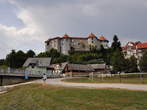
Crnomelj is the central and the biggest town in Bela krajina. It lies high under the confluence of the river Lahinja and at the affluent of the river Doblicica. Crnomelj was settled since the older Iron Age. The city has because of its geographical position, beside the main road, only two parallel streets. This has changed only a little with the years. Crnomelj is first mentioned in the year 1228 with the name Schirnomel. The city got town rights in the year 1407. Crnomelj was in the 15th century secured against Turks with the walls and they also dug out the moat. The important things to see in the old city centre are Castle Crnomelj, the Komenda (Commandery), Stonic Castle, Church of Saint Peter, Church of the Holy Spirit and others. In the year 1944 was established the first partisan gymnasium in Slovenia. Crnomelj Castle was first built in the year 1165. The bigger castle was built later and with some additional extension is preserved to these days. In the 13th century was also established the Komenda of the Knights Templars. The inner yard has renovated arcades. Here are also exhibited Roman tombstones. Stonic Castle lies opposite of the Castle Crnomelj. It is built of the three buildings, which were in the year 1768 united in one. Castle was announced for the cultural statue in the year 2003. The Church of Saint Peter originate from the year 1228. The baroque hall is from the first half of the 18th century. The Gothic church of the Holy Spirit is first mentioned in the year 1487. It was renovated in the end of the 19 th century, together with the walls for protection. Črnomelj is the traffic centre of the Bela krajina, because of its central position. At the same time is also the cultural place, famous of the traditional »jurjevanje«, a three-day festival in mid-June of music, dance and bonfires. It is one of the most important celebrations of folklore in Slovenia.
Crnomelj is the central and the biggest town in Bela krajina. It lies high under the confluence of the river Lahinja and at the affluent of the river Doblicica. Crnomelj was settled since the older Iron Age. The city has because of its geographical position, beside the main road, only two parallel streets. This has changed only a little with the years. Crnomelj is first mentioned in the year 1228 with the name Schirnomel. The city got town rights in the year 1407. Crnomelj was in the 15th century secured against Turks with the walls and they also dug out the moat. The important things to see in the old city centre are Castle Crnomelj, the Komenda (Commandery), Stonic Castle, Church of Saint Peter, Church of the Holy Spirit and others. In the year 1944 was established the first partisan gymnasium in Slovenia. Crnomelj Castle was first built in the year 1165. The bigger castle was built later and with some additional extension is preserved to these days. In the 13th century was also established the Komenda of the Knights Templars. The inner yard has renovated arcades. Here are also exhibited Roman tombstones. Stonic Castle lies opposite of the Castle Crnomelj. It is built of the three buildings, which were in the year 1768 united in one. Castle was announced for the cultural statue in the year 2003. The Church of Saint Peter originate from the year 1228. The baroque hall is from the first half of the 18th century. The Gothic church of the Holy Spirit is first mentioned in the year 1487. It was renovated in the end of the 19 th century, together with the walls for protection. Črnomelj is the traffic centre of the Bela krajina, because of its central position. At the same time is also the cultural place, famous of the traditional »jurjevanje«, a three-day festival in mid-June of music, dance and bonfires. It is one of the most important celebrations of folklore in Slovenia.
The Soteska Manor is located in the road between Novo mesto and Zuzemberk. Among the Second World War was destroyed by fire and today remained only the ruins. The manor was built in the years from 1664 to 1689 by count Jurij Ziga Gallenberg. The owner made the castle park designed in renaissance style with the garden pavilion, which has today the name Hudic turn. The building has the ground plan in the form of the fourfeathery clover. In the pavilion are partialy preserved the wall paintings. By opinion of the Janez Vajkard Valvasor, the manor was one of the most beautiful and prominent in the Kranjska Region. It is located in the left bank of the river Krka and it has replaced the medieval castle Stara Soteska in the right side of the river Krka, which was in the 15the century highly damaged. The manor is built in the shape of the regular rectangle. The inner arcade yard was surrounded with four two-storeyed tracts and four corner towers. The Soteska manor was famous by rich painted rooms, which author was master Almananch. Gallenberg’s were the owners of the property Soteska from the year 1733 and then they sold it to the counts Auersperg. In the year 1743 they bought it the counts Lichtenberg and kept it till the year 1793. At that time the owners were ones again the Auersperg’s and they had it till the end of the Second World War. The economical strength of the property Soteska in the 19th century was leaning in the exploitation of the extensive Roska woods. From the middle of the 19th century is working the saw in the right bank of the river Krka. The manor was destroyed in the year 1943 by fire from the partisans. They also took away all the precious equipment and after the war the local people used it as the quarry. The hydroelectric power station from the year 1927 in the left bank of the river preserved all the technical instruments. The visitors can see the exhibition storehouse of the Technical museum Slovenia and the Hudicev turn only by the previous arrangement in the Commune Dolenjske Toplice.
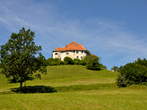
Castle Bizeljsko (Wissel) is situated on a rocky hill above the village Bizeljsko. Castle gives the village its characteristics appearance. In written sources is first mentioned in 1404, when the region was inhabited by knights Wissell. The castle has a medieval layout. Throughout the centuries has played an important role as a defensive post. Today the Castle Bizeljsko has Renaissance and Baroque features. Renaissance form can be seen at the entrance, when the Chapel of St. Hieronim with rich Baroque altar was added to a building. The chapel originates from 1623. The arch of the chapel and three rooms on the first floor are decorated with stuccos from the late 18 th century. Rooms were built as a series of continually spaces. A rectangular courtyard is surrounded by four two -storeyed tracts. On the west side are at the corners round towers. In the Castle Bizeljsko did not keep the valuables, because everything took away its last owners, counts Windischgraetz. Today is in the castle the wine chapel Klakocar. The family Klakocar also restored the castle rooms. We can see the rich wine cellar and the castle chapel. Beside famous wines from Bizeljsko is in the cellar preserved the autochthon sort named Rumeni plavec.
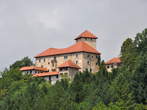
The Gradac Castle is situated in the village Gradac in the Community Metlika in Bela krajina. The castle stands in the good protected area of the river Lahinja. There is a footpath to the Gradac Castle, which secedes from the main road next to the store. We come to the castle over the wooden bridge, which goes across the former defensive dyke. In the sources was the castle first mentioned in the year 1326 as Gräcz. At the beginning the Gradac Castle was probably the stronghold against the Turks. It was in the property of the Italian family counts Thurn-Valsassin, until it came in the possession of the family Burgstall, which were also the owners of the Krupa and Pobrezje Castles. The next owner was Jurij Gusic, who marked the castle with reconstructions. His tomb is situated in the castle park. He died in the year 1831. In the gable of the castle porch we can see the coat-of-arms of the family Gusic. The castle was in the year 1846 bought by Franz knight Friedau. He built in Gradac in the year 1858 foundry for iron with smelting furnace and supplied it with copper ore, which was digged out in Bela krajina. The last of the owners of the Gradac Castle was before the second world war wholesaler Sutej from Zagreb in Croatia. In the castle was between the war transitional partisan hospital, in the years from the 1944 to 1945 was alsto the officer school. After the war there was the school for hard educable children. Afterwards there was the agricultural and domestic school. However, after the year 1956 there were apartments. The Gradac Castle had a park with garden and avenue planted with plane and pine trees, but it is cut down now. The park belongs to the garden architectural heritage.
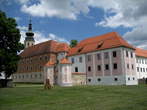
The Bozidar Jakac Gallery is situated in Kostanjevica na Krki. It was established in the year 1974. Most of the pictures are from expressionists. The first starts of the gallery goes back to the year 1956, when was in the places of the elementary school established The Gorjup Gallery. The Gallery Bozidar Jakac is situated in the rooms of the former Cistercian monastery, which the local people also call it Kloster or Kostanjevica Castle. Before the entrance to the gallery is beautiful lime avenue, which in summer times gives nice shadow. The Church of the Virgin Mary and the cloisters are the oldest part of the monastery. The church originates from the middle of the 13th century. In the 18th century was renovated to the baroque style. The wall above the main entrance was painted in the year 1737 by Franc Jelovsek. In the 19th century the monastery was condemned to dilapidation, but the worst part was, when the monastery was burnt down between the Second World War. Furthermore, in the year 1956 was destroyed the church tower. The renovation began soon after the war, under the direction of the France Stele. It is still continuing today, under the cover of the group of the institution for the protection of the natural and cultural heritage. In the gallery are permanent exhibitions of Joze Gorjup, Tone Kralj and Bozidar Jakac. Gradually, with renovation of the rooms, the gallery has the exhibitions of France Kralj, Zoran Didek, France Gorse and Janez Boljka. Specially interesting is the art collection of old masters from the nearby Pleterje monastery. The castle grounds are used to exhibit over 100 large wooden sculptures from Forma Viva, an international exhibition once held in several places in Slovenia from 1961 to 1988 whereby sculptors worked with materials assosiated with the area. Here it was oak, in Portorož stone, iron at Ravne in Koroška and shudder concrete in Maribor. In the future Forma Viva will be organized every two years. Lamut Art Salon is dislocation of the gallery and is situated in the city centre. The painter and graphic artist Vladimir Lamut completed a large portion of his work here in Kostanjevica.
 KRAJI - Slovenia
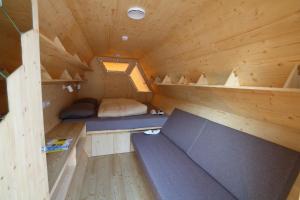 Višnja GoraHoneybee Hostel - Hiša kranjske čebele