Source: Public information of Slovenia,
The Surveying and Mapping Authority of the Republic of Slovenia,
State map in measure 1 : 1.000.000, 1995
www.gu.gov.si
Marezige is a picturesque village located in Slovenian Istria. Administratively, it belongs to the Municipality of Koper, which is one of the most divided Slovenian municipalities. The settlement lies above the Vanganelska valley and is about ten kilometers from Koper.
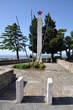
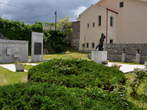
The settlement covers several hamlets on the ridge and slopes of the Marezgan ridge, between the valleys of the Rokava stream in the south and the Badasevica stream in the north. On the ridge, the village of Burja is exposed to the burja wind. On the northern slope are the hamlets of Brzani and Sabadini, and on the southern slope are Rokavci and Bernetici. Marezige has a rich historical past. In the second half of the 8th century, Istria passed from Byzantine to Frankish rule. Istrian cities have felt the influence of Venice since the 9th century, and after a long period of independence in 1279, they had to accept their rule, which lasted until the collapse of the republic in 1797. For a short time, the village belonged to Napoleon's France. At first they were part of the Kingdom of Italy, but from 1809 they were part of the Illyrian provinces. The municipality of Marezige was founded in August 1898 and at that time belonged to the Austrian littoral. A varied political and cultural life took place in the place. A loan company and a savings bank were established. After the First World War, Istria was annexed to Italy. The authorities persecuted the Slovenian population and closed Slovenian schools. In May 1921, the locals finally revolted and challenged the fascists. At the trial in 1923, the Italians sentenced many locals to several years in prison. Marezige rebellion belongs to the first forms of resistance against fascism. In memory of this event, the municipality of Koper celebrates a municipal holiday, and the elementary school in Marezige was named after Ivan Babic, who was the leader of the resistance. During the Second World War, a partisan school was founded in Marezige. In October 1943, the Germans burned the houses in the village and killed the hostages. The primary school was rebuilt in 1949. After the war, Marezige got electricity, they modernized the road and they got water from Rizana waterworks. The Monument to the National Liberation War and the pre-war victims of fascism is located in the center of village, opposite the seat of the local community, along the road Koper - Marezige. The design and arrangement project of the monument is the work of architect Teja Badjur. The monument stands on a stone-paved plateau. It is a tall square column made of white Istrian stone, which is finished with a red five-pointed star. It was erected in 1958. On the monument there is an inscription by the writer and poet France Bevk, part of which includes the text - We pay tribute to the comrades who fell in the first rebellion against the fascists in the Slovenian littoral and the freedom fighters in the National Liberation War. On the anniversaries of the Marezige rebellion, the traditional Refosk Festival has been held in the village since 1972.
The event grew from a Refoska exhibition into a great celebration of winegrowers and wine lovers. The event promotes wine culture, the quality of wines and the cultural and ethnological heritage of Istria. Marezige is also known for the first wine fountain for wine tasting in Istria.
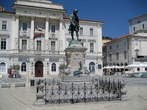
Piran is a wonderful old port town in Slovenian Istria. The city preserved the medieval plan with narrow streets and squeezed houses, which gives it the special charm. Tartini Square is the centre of Piran and the largest square. It got the name by the Giuseppe Tartini (1692 – 1770), the famous composer and violinist. The main square became in the end of the 13th century. The image, which has it today, got in the other half of the 19th century. It began with the covering of the inner port. On the square are Tartini house, the Saint Peter's Church, baroque house, hotel Tartini, interesting stony columns with flag pole, the doors of Saint George, the judge palace, town hall, Tartini memorial, Loggia, Gothic house, called Venetian and other. In the atrium of the town hall we see the polygonal stone with quantity measures and inscriptional slabs with some arms from the old town hall. In the majority in more important buildings were built in the Venetian lions with the open book. The open book meant peace and close book meant war. The loggia was situated in the area of the present Coastal galleries. In the loggia were meeting the town's magnates. Venetian house is a wonderful red building, which was made in the middle of the 15th century. It is the example of the Venetian and Gothic architecture in Piran and the oldest building in the square. The most interesting is the corner Gothic balcony. The bronze Tartini monument was erected in the year 1896. It was made by the Venetian sculptor Antonio dal Zotta. It is connected with the Church of Saint George. The Tartini house is ranged among the oldest houses in the square. It was built in the Gothic style. Later they renovated its exterior in new classical style. The last renovation was in the years from 1985 to 1991. Today is the seat of the Italian Community. In the first floor is the Tartini memorial house. The house is intended for exhibitions, performances and art workshops. The stony pillars for flags are in the entrance to the Tartini square. They are from XV. century. The court house was built in the area, where was in the 14th century Fontik, the storehouse for flour and cereals. The pawnshop town got in the 16th century.
 KRAJI - Slovenia
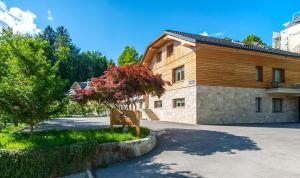 BledVila Alpina