Source: Public information of Slovenia,
The Surveying and Mapping Authority of the Republic of Slovenia,
State map in measure 1 : 1.000.000, 1995
www.gu.gov.si
Recommended
Source of the river Soca in situated in the Trenta valley (Zadnja Trenta). It belongs under community of Bovec. Under the first world war was valley the scene of a lot of battles. River Soca is 137 kilometres long river in north Italy and west Slovenia. It is also named Emerald River because of its wonderful crystal green colour. To visit the source of the river is best to begin in market path from Hut by source Soca which is the mountain post in Trenta. It is most easier approachable from the local road over mountain pass Vrsic. The hut was in the year 1953 reorganized from military building and was later renovated and expanded. It is open from beginning of May till end of October. To see the sight will take you about twenty minutes. The footpath is in good order and in upper part secured with wedges. It is suitable for visitors with proper shoes, but not recommended for children and olders, because of sliping. Karstic source is popular tourist point and it is most beautiful in spring and summer time. Waters in the height 1100 metres highly boil up on day from cave with underworld small lake and through narrow gorge, which is soon broaden. Beside source of the river Soca also begins 20 kilometres long educational footpath. The river flows against south and near Trst in Italy falls into the Adriatic Sea. Snita is the old name for river Soca.
Other
The Spring of Glijun is situated near Bovec. In the centre of Bovec you go to Kanin village, where you drive past and after about 3 kilometres you will come to the village Pluzna. You can park car here and walk by road or you drive about 500 metres forward and park car by the road in the wood. After the path left, where is the direction table, you can also go to the Virje Waterfall. You have to continue the trail straight on for the Spring of Glijun and you will come to the bridge over the Glijun Brook, which offers the brave one pleasant refreshment in the summer times. After the 100 metres of walking you will come to the dike and from there you can see the Spring of the Glijun Brook. The brook is the karstic spring of the Kanin waters. The Glijun Brook flows to the earth from many bigger and smaller springs. The spring has the average temperature 5,5 C.
The source of Hubelj is located about three kilometers from Ajdovscina. The Hubelj River boils daily from numerous holes in the Karst underground that are more or less accessible. The source is especially interesting with the high water that falls from the higher vault in the mighty waterfalls.
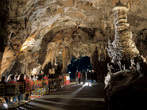
View of the splashed water as the drops come from an altitude of about 240 meters to the bridge, which is 40 feet lower, is wonderful. The waters from the underground flow through three caves, which are the Spider Network, the Great Hubel Cuisine and the Eastern Hubel Cave. During the dry season, about 400 trenches were measured, ending with siphon rolls and piles. Hubelj Spring is one of the main karst springs in the Vipava Valley, also important for its integrity and purity, as it is one of the most potable waters in the valley. In the 16th and 17th centuries, iron smiths and iron foundations operated along the upper course of Hubble. At the time, Hubble was developing into an industrial center, which was the birthplace of today's buckwheat industry. At the time, Hubble was developing into an industrial center, which was the birthplace of today's buckwheat industry. At that time near Hubble an industrial center was being developed, which was the origin of the present-day buckwheat industry. Near the spring is located Guest house Gostilna pri izviru Hublja, where guests can enjoy delicious food and refreshing tea. From Pale Sports Park to the source of Hubelj leads a beautifully arranged Naturalistic Educational Trail.
At the 3,100-meter-long path, you learn more about the basic natural laws through 24 stations. You learn about typical rocks, tree species, shrubs, forest animals, aquatic ecosystems and other peculiarities and characteristics of nature.
 KRAJI - Slovenia
 PtujHotel Murat