Source: Public information of Slovenia,
The Surveying and Mapping Authority of the Republic of Slovenia,
State map in measure 1 : 1.000.000, 1995
www.gu.gov.si
Recommended
Other
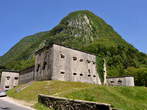
Fort Hermann is part of the stronghold complex of the Kluze Fortress. It was built in the rising ground above the Kluze Fortress. The beginning of the trail is in the nearness of the Kluze Fortress, at the opposite side of the road. Under the steep walls, where the rocks can fall, you will come to the tunnel. The tunnel has lighting and when you walk through, are by side the corridors, which lead to the shooting lines. They started to built the tunnel and the accessible road already in the year 1897. The work was done under the Austrian imperial – royal military construction leadership, which had seat in Bovec and was ended till the year 1906. The tunnel was in The First World War equipped with the three hidden lines, which are still seen now. To the Fort Hermann leaded also the steep trail on the transversal wedges. Today is the trail to the fortress directed with signboards. When you come to the Fort Hermann, you will stop breathing because of its greatness, in spite of that it is very ruined of the passed time. It got the name after the captain Johann Hermann von Hermannsdorf. He was the commander of the Predel fortress in the time of the Napoleon wars. It was built in the year 1900, so that it would support the Kluze Fortress. It was one of the six Carinthia's fortresses. It is also known as the upper Kluze Fortress. The fortresses were protecting the access to Trbiz and to the hinterland of the Austria. In the First World War the Fort Hermann was destroyed by the first greater Italian bombardment and it was not in use till today. You can only see the ruins of the building. In the fortress is standing the information table. You can go by the new stairs to three galleries below Fort Hermann.
Castle Dobrovo is located on a small viewing slope in the village of Dobrovo. The Renaissance two-storey mansion from the early 17th century was built on the site of an older castle.
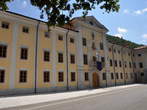
The estate was started to be built by the dukes of Montecuccoli, completed by the Counts of Colloredo, and its last owners were the Baguers. Castle is an undivided rectangular building with square towers. The towers are upstairs higher than the mansion and open to each side with three arches. The courtyard is walled and decorated with cylindrical columns. The walls were probably built during the Venetian War and after the war turned into an arcade corridor and one of the towers into a chapel dedicated to Saint Anton Padovansky. The location of the castle indicates a well-considered layout and layout. Older equipment is scarce, fragments of frescoes with coats of arms and a landscape image preserved by Cement del Neri from 1894 are preserved. The paintings are on the staircase and in several rooms. The extensive renovation of Dobrova Castle, which had been planned in 1979, was completed after 1991. On the first floor of the mansion is the Knights' Hall, where you can see the coats of arms of noble families and a wall painting depicting a naval attack on the city. There are many music and other events in the hall. In addition, the gallery with a permanent collection of prints by world-renowned artist Zoran Music and part of the collection of Count Baguer, the last owner of the castle, is also interesting to see. In the castle cellar there is a hunting room, restaurant and wine cellar of winemakers from Brda.
The former park in front of the castle was converted into a parking lot. Beneath the Castle of Dobrovo is a bronze monument dedicated to the poet Alojz Gradnik, the work of sculptor Jakov Brdar.
Castle Gewerkenegg is located on a small hill in the old town centre of Idrija. The renaissance castle was built in the 16th century for the mine management and the storage of mercury. Castle Gewerkenegg was also a centre of trade with mercury in Idrija. The castle was through the centuries rearranged and upgraded. Courtyard facades were painted in the other half of the 18th century with frescoes, which are now restored and reconstructed. Today is in the castle seat of the Municipal Museum Idrija, which was proclaimed for the best European museum of engineering and industrial heritage in the year 1997. The museum was established in the year 1953. In its care are cultural, historical monuments, technical monuments, natural remarkablenesses and preserved buildings from the Second World War. In the museum they have the permanent exhibition named Five centuries of the mercury mine and the town of Idrija. Photographs of Idrija, exhibited documents, maps and original objects illustrate mining history, the development of floating timber and forestry. In the geological collection are presented minerals, mercury ores, rocks and fossils. In the castle are held many cultural events in the summer time, which attract many domestic and foreign visitors.
Kluze Fortress is situated near Bovec. It belongs to the most powerful and most interesting strongholds. It is lying above the deep gorge of the Koritnica River, in its most narrow part. Before the Kluze Fortress is a small park, where are also the information tables. The primary Venetian fortress was erected in the second part of the 15th century for defence before the Turks. The Venetians were banished away in the year 1509 and the Kluze fortress came into the Austrian possession. It was strengthen at the expense of the Carinthia provincial States and it became the seat of the district. In the second part of the 17th century the governor general of a province Georg Filip von Gera took care for the necessary improvement and completed it. The Kluze Fortress played the important role in the French wars. It was burnt down and destroyed in the year 1797. In the years from the 1881 to 1882 the remains were pulled down and they built the new fortress in the same place. Between the First World War was here the seat of the Austro – Hungarian garrision close behind the front line. After the Second World War it lost its rule and was left to the time. Between the years 1987 and 1991 they protected the roof construction and put in order the surroundings. Inside of the fortress is presented the history of the fortress and its surroundings, the smaller tourist office, wedding hall and local painting gallery. They regularly perform the games of soldiers, which are dressed in uniforms and with the equipment from the period of the First World War. Before the fortress in the direction of Bovec you can see The Castle Well from the year 1670, which is cut in the rocks. In the well was flowing the rainwater. Before that they carried the water from Koritnica River.
Fort Predel is located about one kilometre from the former frontier Predel. It belongs between one of the six Carinthia strongholds. The first fortification was already built in the time of the Napoleon Wars and was burnt down twice in the fights between the French and the Austrians. In the year 1850 they built a new stronghold, which was constructed from the main building on the rising and the smaller barrier by the road. Buildings were connected with the underground passage and walls. Next to the road is situated the monument, which consists from the stony support wall, the pyramid with the carved inscription and the lithoiron statue of the wounded lion. In the honor to defenders was erected by the Austrian emperor Ferdinand I. and was solemnly unveiled in the year 1851. The Fort Predel was reorganized to the military warehouse in the year 1898, because it became obsolete and it did not suited to the changed military regulations. It was renamed to the Depot Predil in the year 1907. After the First World War was no longer maintained, so today can be seen only the walls.
 KRAJI - Slovenia
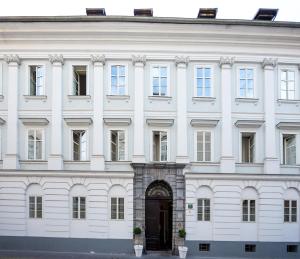 LjubljanaAntiq Palace - Historic Hotels of Europe