Source: Public information of Slovenia,
The Surveying and Mapping Authority of the Republic of Slovenia,
State map in measure 1 : 1.000.000, 1995
www.gu.gov.si
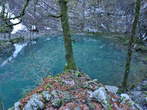
Divje jezero (Wild Lake) is a complex natural phenomenon: a karst cave, a karst spring and a lake at the same time. Its foundation and origin was to a great extent influenced by karst processes and tectonic forces. Above the lake, a fault can be clearly seen, cutting across a hundred metres high walls of folded limestones. On the basis of fossil bivalve remains, geologists were able to establish that the limestones were formed in a shallow sea during the Lower Cretaceous period some 100 million years ago. The water spring at the bottom of the lake from a steep cave passage, which has been researched by divers to a depth of 160 metres. During the dry season, the lake's surface is calm, while during heavy rains a water cone is formed in the middle of the lake, making it look as if literally boiling. From the lake flows the shortest Slovenian river called Jezernica (Lake River), which after covering no more than 55 metres drains into the Idrijca River. The surroundings of the lake are inhabited by numerous animal and plant species. The steep and cold slopes are favoured by thermophilous plants. The cave is inhabited by the White Olm Proteus anguinus, the only European cave vertebrate, as well as by some other water cave animals. Divje jezero has been attracting nature historians for almost 250 years. In 1967, Divje jezero acquired the status of nature monument and museum in nature.
 KRAJI - Slovenia
 LjubljanaONE66 Hotel