Source: Public information of Slovenia,
The Surveying and Mapping Authority of the Republic of Slovenia,
State map in measure 1 : 1.000.000, 1995
www.gu.gov.si
Recommended
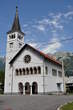
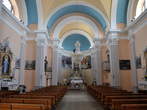
The most beautiful World War I monument is a wooden shrine that rises high above the Tolminka riverbed – the memorial church of the Holy Spirit in Javorca. The church in the walley of Polog was built by Austrian soldiers in 1916, to the design of the Austrian architect Remgius Geyling.
The outside of the church is decorated with stylised coats-of-arms of all the monarchies and lands of Austria-Hungary. The interior is classic art nouveau, adorned with colourful decorations. The idea of a memorial church is communicated through engraved oak plaques bearing the names of all the Austro-Hungarian soldiers who lost their lives on the hills of Vodil vrh, Mrzli vrh, Rdeči rob and Sleme.
Owing to its predominantly wooden construction, prone to rapid decay, and severe weather conditions, the church has undergone several renovations, the most recent one being in 2005. The church in Javorca was proclaimed a historical monument with the 1990 Order declaring natural and historical monuments and natural attractions in the Municipality of Tolmin.
Other
Kojsko is an interesting village, which belongs to the Municipality of Brda. The place was until the First World War the economical and cultural centre of the eastern part of Goriska brda. Kojsko is today a region, which is intensively engaged in viniculture.
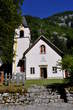
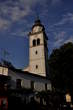
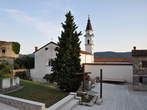
The Gothic Church of the Holy Cross is situated on a hill above the village. The church is part of a former camp, which was built among the Turkish invasion in the 16th century. During the French occupation were destroyed three towers, only one preserved till today, which is now a church tower. To the Gothic church leads the Stations of the Cross.
In the Church of the Holy Cross we can see the largest and almost only preserved Gothic wing altar in Slovenia, which is probably a work of the Villach carving workshops. The main wing altar from 1515 is composed from three parts of gothic carving, which represent themes of Christ’s suffering and his crucifixion. Many Gothic statues and other things disappeared, when the altar was transferred to Florence during the First World War.
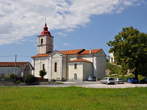
The Church of Our Lady is located on the plain along the main road in Log near Vipava. It is considered one of the largest and oldest pilgrimage churches in Primorska. The church was built in 1619. Already in the 10th century, a chapel was supposed to be built in its place, but the church was first mentioned in written sources in 1430. The Church of Our Lady is a three-storey building with three bell towers. Today's building dates back to the beginning of the 17th century and was enlarged and renovated in the 19th century. At that time, Geraldon, a Venetian sculptor, rebuilt the grand altar in classicist style. The side naves were turned into eight chapels and baroque altars were erected in them. In the presbytery of the church are frescoes by the painter F. Kurz von Goldenstein from the mid-19th century, the first example of Nazarene painting in Slovenia. The church accommodates about 4,000 people and is often the venue for major ceremonies. Next to the church is a monument to the pioneer Paul Rostas, a Hungarian commander who fell in fierce battles with Napoleon's army. Near the church is the famous Renaissance mansion Zemono, which is a popular destination for romantic weddings. In the basement there is a top catering restaurant Gostilna pri Lojze.
 KRAJI - Slovenia
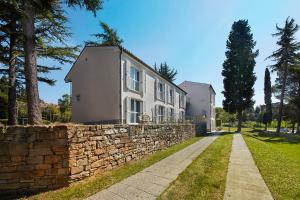 AnkaranVillas - Hotel & Resort Adria Ankaran