Source: Public information of Slovenia,
The Surveying and Mapping Authority of the Republic of Slovenia,
State map in measure 1 : 1.000.000, 1995
www.gu.gov.si
Recommended
Other
Prosenjakovci is a small village in the Municipality of Moravske Toplice in the Prekmurje region, near to the border with Hungary. There are two small churches in the settlement. The village is the site of an unmarked grave associated with the Second World War.
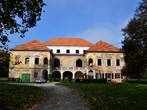
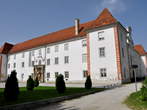
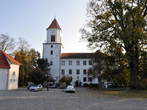
Matzenau Manor is located near the centre of the village. The two-storeyed manor, mentioned in records as a castle from 1876, was a luxurious edifice (26,5 x 15,5 x 9 meters high) built in a neoclassical style, and used as a seasonal and hunting residence by numerous owners, who lived in Austria or Hungary. The structure is said to have been built at the beginning of the 19th century by Italian architects. Around the building there was a park with a resting benches and fountain. The entire premises spanned an area of approximately 150 hectares (400 acres). As part of the Carpe Diem project the park has once again regained its original image, since it is being restored to the charm and the purpose for which it was designed. It is surrounded by a trail which also serves as an access to the manor.
The benches along the trail offer an opportunity for the visitors to enjoy and rest the untouched nature, and the information panels give them some information on our native three species and their peculiarities. In 1900, Denes Craigher bought the manor from Carl von Matzenau.
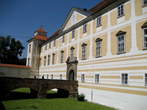
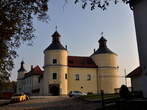
Radgona Castle is located in the Gornja Radgona, which lies in the right bank of the river Mura. The city is situated by the main road from the Murska Sobota to Maribor, at the border with Austria. Gornja Radgona is lying in the hill Grajski gric. It is famous by annual agricultural fair. Radgona Castle was first mentioned in the 12th century. It stands in the hill from there is a beautiful view to the surroundings. It was built by the aristocrat with Slovenian origin Radigoj. Its first owners were counts Spanheim. Through the centuries the owners were different several times. The present image the castle got in the year 1775 by the count Leopold Herberstein. The last owners were counts Chorinsky. They sold it in the year 1931 to the ban's administration. In the Radgona Castle was by the Second World War the elementary school. Now is the castle in the lease of the local man Milan Herzog. At the present he is renovating this beautiful building. In the castle is also the wedding hall. Radgona Castle was several times enlarged and rebuilt. The entrance is through the external yard. You can first visit the two-storeyed building. They were preserved the apertures for the chains of the lifting bridge. The main gates are massive and lined with sheet metal. Above the entrance you can see the blazon of the counts Herberstein. At the end of the court you can come to the other entrance. Here you can see the apertures of the lifting bridge, which means that was here the internal castle ditch. In the portal is the double blazon of Herberstein-Eggenberg. You can come to the other yard by the longer corridor, which is by all four sides arcaded. The main three-storeyed castle building is entirely under the cellar. Sometimes the castle also had its 56 metres deep fountain. The top of the castle is concluded by the small tower. Beside the castle, opposite of the first entrance, was more than 50 metres long chesnut promenade. Radgona castle will be reorganized to the representation building.
Grad Castle is located in the village Grad in Goricko. The village Grad is the biggest and the oldest settlement in Goricko. The castle is a cultural memorial and it is very important in the state level. It is protected with its surroundings and castle park as the artistry, architecture and cultural memorial. The castle is the big trump for the touristical resuscitate of the village Grad. The local people wants that the castle would be live again as the centre of the political, economical and cultural life of the region. Grad Castle is at the moment under the renovation. It is the biggest castle complex in Slovenia. It has over 365 rooms. The history of the castle goes to the year 1208. The owners were frequently different. Between the First World War and the Second World War were its owner the industrial Geza Hartner from Murska Sobota. At that time was equipped with art works and very well preserved, afterwards was till the renovation long time abandoned and left to the destruction. Inside of the castle is the fountain, which is insured with plate and cut in the vivid rock. In the time of the attacks and sieges had played the important role. In the castle yard is the focal point of the energetic forces. The vibrations of the castle radiation should heal different illnesses. The visitors can see only one part of the rooms. It is open the wedding room, smith's, potter's and wheelwright's workroom and some of the ethnological collections. It is also available the smaller souvenir shop. The biggest traditional performance is the Night of the witches.
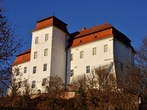
Slovenska Bistrica Castle is located in the immediate nearness of the city centre. It is the powerful building, which can be hardly missed. At the castle is the park, which attracts locals and other visitors in every time of the year. The Slovenska Bistrica Castle was first mentioned in the year 1313. It has variegated history, because it changed the owners several times. At the beginning it was in the ducal lands. In the year 1587 bought it the aristocratic family Vetter, later von der Lilie. The next owners were the family Wildenstein before the end of the 17th century. They are famous by the forming of the Bistrica Castle Park. The counts Attems bought it in the year 1717 and it remained in their property till the end of the Second World War in the year 1945. Today is the castle the cultural centre of the city. It is carefully renovated since the year 1985. In the Slovenska Bistrica Castle you can see the permanent exhibitions like the room of flags, Roman road Celeia – Petovio, the exhibition Ancnik ancient fort, Ark’s ethnologic collection, collection of the wines of the Bistrica growers, collection of the prayer books, collection of the oil lamps, collection of the puppets in the typical costums of the world, Pajtler’s collection of the fossils and minerals, collection of the minerals from Communes Slovenska Bistrica and Oplotnica, Ingolic memorial room, stoneware of the Pohorje, Castle’s smokehouse with the old castle hour and Tomazic memorial room. In the castle are also the artistic saloon, chivalric hall in which they organize different cultural performances, the wedding hall and the gallery Castle. In the summer time they organize the traditional old Bistrica evenings. They have the permanent guide service.
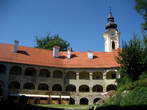
The Maribor Castle is one of the most remarkable architectonic monuments in Maribor. Today is here the seat of the Regional Museum of Maribor. On the facade you can see the table in the memory of Franjo Bas, who organized the museum and archives. The Maribor Castle is decorated with different architectoral and style periods. It was built by Friderik III. between the years 1478 and 1483 to strengthen the town's walls because of the threatening Turkish attacks. Later was changed to the rich feudal residence. At the western side of the castle is the wonderful baroque staircase from the years 1747 and 1759. In the northeastern corner the eastern façade is concluded with the castle bastille, which had represented the defensive point by the town’s dike. It is the work of the building contractor Domenica dell' Allio from the years 1556 to 1562. At the northwestern side you can see the powerful tower. Loret’s chapel at the southern side was made in the years from the 1665 to 1675. Festive hall or the solemn hall represents the central place of the Maribor castle. On the roof you can see the image of the horse battle between the Turkish and the Christian war, which was painted by Johann Gebler in 1763. In this place gave the concert the famous Hungary composer and pianist Franz Liszt. Some well known people resided in the castle including: Emperors Leopold I. and Karl VI., Empress Maria Teresia, Russian Crown Prince and later Car Pavel I and Pope Pius VI.
Ptuj Castle is a powerful building, which is proudly rising above the town. The castle complex is composed from the former administrative building, central castle building, granary, stables, southern right-angled tower, west tower, southern round tower, northern tower, castle farm and castle walls with three portals, early medieval terrestrial dyke and guardhouse. All the buildings are located in the castle hill. Ptuj Castle has a varied historical past. The medieval stronghold was built in the 11th century, but the castle hill was already settled from the 5th Millenium before BC. The important owners were the Salzburg arcbishops, the Lords of Ptuj, the Leslie Family and the Herberstein Counts. After the Second World War the castle was nationalized. In the Ptuj Castle is today a museum. Collections in Ptuj Castle are the Collection of Arms, the Collection of Musical Instruments, the exhibition on Feudal Dwelling Culture, the Castle Gallery, the Collection of Traditional Carnival Masks, the Ethnological Exhibition and the Collection of Traditional Carnival Masks. Periodical exhibitions are the Leslie Family, the Sluga Collection and the Lords of Ptuj. The most representative place in the castle is the festival hall with the small chapel, which is convenient for solemn occasions as are weddings, symposiums, concerts, business meetings and other. From the Ptuj Castle is a wonderful view to the town Ptuj and the nearby surroundings.
 KRAJI - Slovenia
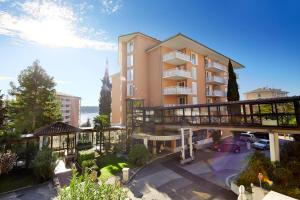
 Rimske TopliceRimske Terme Resort - Hotel Rimski dvor