Source: Public information of Slovenia,
The Surveying and Mapping Authority of the Republic of Slovenia,
State map in measure 1 : 1.000.000, 1995
www.gu.gov.si
Recommended
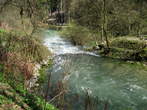
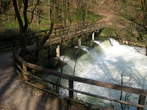
The Kamniska Bistrica mountain hut is located at the upper end of the Kamniška Bistrica valley and lies 13 kilometres from Kamnik. Several karstic springs of the river Bistrica flow nearby, which empty into a wonderful green lake. You can find two small donkeys, who love to be photographed and are an attraction for the children. You can also discover a playground and the beautiful renovated chapel of Lurska Marija. Originally, this was a hut converted from the Turistovska home in May 1909. This mountain hut has had its present form since 5 May 1929. After the Second World War it was managed by the Ljubljana Mountaineering Association and has been renovated, reorganized and modernized several times. The mountain hut is open from mid April to mid October, but it can also be opened for larger groups at other times. It has a wonderful view of the wreath of Kamnik Alps, which surrounds the valley. To the east is a view between the narrow valleys of Sedelscka and Kamniska Bela, the southern slopes of Rigeljc and Mešenik, to the Southeast of the valley lie the western slopes of Velika planina, to the south ther is a wide view of the eastern slopes of Mokrice from the Krvavec range, to the west, above the valley slopes is the Kalški crest. The most beautiful view is found to the Northwest of Kamnik Alps, where, behind the top most edge of Veliki Podi, Skuta, Struca, the Mlinarsko saddle and the top of Grintavec can be seen, to the North side of the valley is Southern Brana.
Other
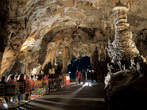
The River Krka springs in the Krka Cave in the 268 height above see level and then it flows into the river Sava at Brezice. To the spring you can come after the pleasant walk throug the village Gradicek. The Karst spring is under the rock, where is the the entrance to the original Krka Cave. The examination of the cave is possible only with the tourist guide, which will accept you before entering to the cave. The cave is open from April to October. For the public was opened by the Tourist association Krka in the year 1996. The Krka Cave is 200 metres long and wide about 30 metres. The chamber is concluded with the 30 metres long siphon lake. The siphon goes after the 210 metres into the spacious, 60 metres long final cave. The common length of the researched tunnels is about 490 metres. It is the horizontal cave, from which vomits the underworld water only by overflowing. The floors are covered with large boulders and rubble, which are in the eastern part piled up all to the stamp. In the cave is the constant inhabitant the human fish. The Krka Cave was sometimes the shelter for the local people. About that wrote Josip Jurcic in his novel Jurij Kozjak. The first one, who put down the visit of the Krka Cave, was Janez Vajkard Valvasor in the second part of the 17th century. The first plan of the Krka Cave was made in the year 1887 by V. Hrasky. The main entrance was wide open in the year 1937, so that they could made possible the faster outflow of the underworld water and so save the problem with the floods in Radenska field. The cave divers have only in the year 1995 swam across the labyrinth of the underwater tunnels and broke through the final Vrhoved chamber. River Krka is the longest and completely Slovenian river. It has 94 kilometres of surface stream and rainy – snowy regime with the highest water in autumn and the lowest in summer. It’s river basin is extended over the 2284 square kilometres. Krka River is the only tufa producing river. Its water is saturated with the limestone, which from the village Marinca to Otocec eliminates like tufa and forms the characteristic barriers and thresholds. In the past there were numerous mills and saws, but today is prevailing more the recreative and tourist meaning of the river. Particulary is attractive for kayaking and fishing. Because of the pollution waters in the Karst hinterland is the Krka River already by the source ranged to the second quality rank. Its quality goes worse in the middle and lower stream, where is in the second and third rank. Above the village Gradicek is located the Poltarica Cave, the neighbour of the Krka Cave, which was uncovered in the year 2003. The cave is above the source of Poltarica, the first afflux of the Krka River. It is ornamented with many stalactites, curtains, tubes, five siphon lakes, human fishes and rapids. Poltarica Cave is not open for tourists, but you can see it in the attendance of the cavers.
 KRAJI - Slovenia
 CerknicaDom na Slivnici