Source: Public information of Slovenia,
The Surveying and Mapping Authority of the Republic of Slovenia,
State map in measure 1 : 1.000.000, 1995
www.gu.gov.si
Recommended
The Preseren Square is one of the most beautiful markets in Ljubljana, which is especially popular by Ljubljana residents. It is known for its red Franciscan church of the Annunciation, the beautiful Plecnik Bridge - the Triple Bridge and the Preseren Monument.
The market is lively, there are many bars and shops here. The market was first called the Animal Market, later it was named after the church Mary's Square, and then after the Slovenian poet France Preseren. It lies at the junction of the old medieval town with the new, which spread from the 19th century on the left bank of the Ljubljanica River. It is actually a crossroads, into which five streets converge, which then merge onto the bridge at the gateway to the old town. The space was interesting and important in the Middle Ages, because through it and then through the Spital City Gate, which stood at the beginning of the wooden bridge, the ancestor of the present Triple Bridge, flowed into the walled city most of the commercial traffic. Here in front of the city gates, a shop flourished in the 16th and 17th centuries. Merchants erected their stalls and huts in front of the gates and on the bridge until they were banished from there in the 19th century and built masonry storefronts in Copova Street, which have survived in part to this day.
Ever since, there was also a church on the square, which was originally Augustinian, and in the 18th century the Franciscans moved there from Vodnikov Square. By the end of the 18th century, when Preseren Square was demolished, the city walls were markedly suburban. Like most of the markets outside Ljubljana, it was regulated only in the first half of the 19th century. At that time they also paved it, and it started to look more urban. In the years 1841-42, they built a new stone bridge instead of the old one and named it after the brother of Emperor Ferdinand the Francis Bridge. The year can still be seen today above the vault of the middle bridge. The Preseren Square changed the most after the earthquake of 1895. At that time, they demolished the old house, which stood on the site of the present Presern monument, and built new, stylishly designed buildings, in height adapted to the crown of the Franciscan church.
During the two wars, the square was rebuilt again, at which time a new Mayer Palace was erected, the work of architect Stanko Rohrman, and two additional pedestrian bridges were built along the Franco Bridge - today's Tromostovje. Preseren Square is one of the most vibrant and attractive spots in Ljubljana.
Other
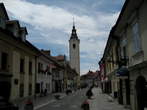
Kamnik has an interesting old town centre. The central part of the old town centre is the Mali grad (Small Castle) around which are situated the following squares and streets: Glavni trg, Samostanska ulica, Sutna, Sadnikarjeva ulica, Trg svobode, Prešernova ulica, Maistrova ulica, Franciskanski trg etc. On the Glavni trg are situated the Gallery of Miha Males, Tourist information centre, the Coffeehouse Veronika, where are taking place cultural and entertainment events, the stony fountain, which is the work of the sculptor Leon Homar etc. At the end of the Glavni trg is the statue of general Rudolf Maister on the northern side. In Samostanska ulica and Franciskanski trg stepping out the most the Franciscan Monastery with the library and the Church of Saint Jacob. Their beginnings are from the end of the 15th century. Sutna is surrounded with series of houses from the both side of the street, which has been unchanged since the second half of the 19th century. This part of the town is closed for traffic and belongs to the protective part of the town centre. Sometimes Sutna was the suburb part of the medieval Kamnik. Here we can see the birth house of general Rudolf Maister.
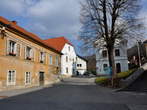
Polhov Gradec has an interesting old village centre. We can see cultural remarkableness as are Ostetar house, Curacy, street Usrana gasa, house Pri peku, Sever house, inn Gostilna pri Pratkarju, the Culture home of Jakob Trobec, monument for the National Liberation War, church of the Birth of Mary and other. The old village centre is mostly serried round the Church of the Birth of Mary, which was built in years from 1728 to 1736 in the baroque style. It got the present image in the 19th century, when it was increased together with the belfry. Inside is the most interesting golden baroque altar, which was made by the local carver family Facija from the forties in the 18th century. Their workshop was famous because of the excellent quality of work. The village houses were mostly made in the 19th century. They have decorated portals with vegetable and geometric motives. Ostetar house was made in the 16th century. It preserved the late Gothic and baroque windows. It is still original wooden roof inside, stony staircase and stonecutting shaped portals. The Curacy is from the year 1803 and it is the oblongness building. In the street, which is called Usrana gasa, houses got their names by occupations of tradesmen. The house Pri peku (At baker) is from the year 1838 and has the ornament stony portal. The upper part of the house has a typical numerous window openings. The Sever house shows the village life in the 19th century and we can also see the preserved black kitchen. Pristava is the region on the left bank of the Bozna River. Most important house there is inn Gostilna pri Pratkarju, which has the wooden corridor with small column fense.
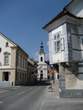
Vrhnika is a town, which is a centre of Municipality of Vrhnika. It is located by the old road from Ljubljana to Postojna. It lies on the slopes of Pokojnik plateau and on the western side of Ljubljansko swamp. The beginning and development of the city is connected with ships and traffic on the Ljubljanica River, which springs here on several places. Vrhnika is also situated on area, where is the shortest passage from Ljubljana basin over the karst and Inner Carniola forest plateau to the sea. The place of today's Vrhnika was already settled before the arrival of Romans. In written sources is first mentioned in 1300 and at that time was named Upper Ljubljana.
In the city we can see the following major attractions: the monument of greatest Slovenian dramatist, poet and writer Ivan Cankar (1876-1918), the birthplace of Ivan Cankar, Lavrencic House – the Old Post Office, a former Hotel by Black eagle, the Church of Saint Lenart, the Church of the Holy Trinity, the Church of St. Paul on the Hill and other.
The birthplace of Ivan Cankar is separated into a black kitchen, living room and chamber. It was proclaimed for a cultural monument. Lavrencic House belongs between the most important and oldest buildings in Vrhnika. It is located on the bank of the Ljubljanica River, where was sometimes a passanger port. A Hotel By Black eagle was built in 1850. By the Church of St. Lenart are buried Ivan Cankar's parents. The Baroque style church got in the 18th Century. It was built around 1640. The Church of Saint Paul is located on the place of the former Roman camp and was built in 1851.
 KRAJI - Slovenia
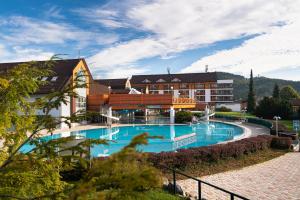 ZrečeTerme Zrece - Hotel Vital