Source: Public information of Slovenia,
The Surveying and Mapping Authority of the Republic of Slovenia,
State map in measure 1 : 1.000.000, 1995
www.gu.gov.si
Recommended
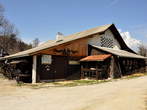
Technical Museum of Slovenia is situated in the former monastery and later cahteau area of Bistra. Bistra is located in the nearness of Ljubljana, between Vrhnika and Borovnica. The museum is housed in 6000 square metre of area. It lies in a wonderful surrounding with park, forest educational trail and pond. In the museum they have permanent collections from the fields of water drive, forestry, wood processing, hunting, fishing, electrical engineering, textile engineering, vehicles and traffic, agriculture and printing. In Sunday they organize demonstrations of old ways and technics, machines and devices, which were used by everyday work. They have demonstrations of milling of flour in the mill on the water drive, working of a circular saw, agricultural and textile machines and other. The wood department shows the contemporary forestry, wood as the source of the energy and raw materials, forest educational way and the ecology of the wood. The forestry department is the continuation of the wood department and is divided to external and internal. It contains thematic complexes as are carpentry, merchandise, joinery, cooper's trade, wheelwrights's trade, production of chairs and sawdusting. The hunting department shows the history of hunting and games in Slovenia. The fishing department shows the history of fishing, fish farming, fishes in Slovenia, technics of fishing and the ecology of waters. The electricity department shows the life and the work of the great inventor, Nikola Tesla and the development of the electrification. The textile department shows the textile trade, industry, raw material, testing of the textile goods and European textile path. In the traffic department are interesting collections of cars before and after the second world war, cars of Josip Broz – Tito, cars of national production, motors and bikes. The agricultural department shows the collections from grain to bread, drive machines, forge's and wheeler's workshop. The printing department shows the history of printing technics and printed words in Slovenia. The Technical museum of Slovenia in Bistra is closed on Mondays, in December, January, February and in first November.
Other
Ljubljana has been the capital city of Slovenia since 1991. It is a popular tourist destination that attracts visitors throughout the year. It was first mentioned in written sources around 1120.
Today, Ljubljana is the cultural, administrative, transport, economic, political, research, and educational center of Slovenia. Ljubljana Castle, a mighty medieval fortress, is a symbol of the capital. It stands on the edge of Castle Hill, just above medieval Ljubljana. You can reach the castle by car, take the funicular railway from Krek Square in the old town, or walk along one of the well-maintained trails. Ljubljana Castle evolved from a fortified tower with a defensive wall, even before the first mention of Ljubljana. On the hill where the castle stands, human presence has been confirmed since the late Bronze Age. Throughout its rich and varied history, Ljubljana Castle has undergone many changes and witnessed important events that influenced the development of Ljubljana and Slovenia. At the end of the 18th century, the Habsburg owners wanted to abandon it, but did not demolish it due to protests from the Carniolan provinces. The castle was purchased by Mayor Ivan Hribar on behalf of the city in 1905, and he transformed it into a cultural center. In the early 20th century, the city of Ljubljana bought the building, and many renovations began, with plans drawn up by well-known architects such as Plečnik, Mihevc, Kobe, and Ravnikar Jr. The castle's current appearance is the result of the efforts and ideas of Projective Bureau Ambienti d.o.o. from Ljubljana.
Their contributions to the renovation include the funicular railway, the Slovenian History exhibition, the Erasmus Tower, the Frederick Tower, the circular route around the castle, the lapidary and mini-theatre, the archers' tower, the castle inn, wedding halls, the bastille, the Puppet Museum, Hribar Hall, the wine cellar, terrace, and more. Today, Ljubljana Castle is an extremely attractive tourist destination and hosts many concerts, cultural events, film and theater performances, and exhibitions. Visitors can explore various parts of the castle, such as the tower, the Chapel of St. George, the permanent exhibitions on the Penitentiary and Slovenian History, Dwelling Hall, Frederick Tower, Frederick's Room, the Arts Sales Gallery, Shooter Tower, and the Pentagonal Tower. The Virtual Castle offers a 12-minute projection on the history of the castle, its architectural development, and archaeological findings.
The Castle Cafe serves typical Slovenian dishes with a modern twist, while the Castle Cafe offers a wide selection of coffees, beverages, fruit bowls, cocktails, and desserts. During the summer, the castle courtyard hosts various events, the most popular of which is the "Movie Under the Stars" screening.
 KRAJI - Slovenia
 PortorožOld Road Rooms and Apartments with Pool