Source: Public information of Slovenia,
The Surveying and Mapping Authority of the Republic of Slovenia,
State map in measure 1 : 1.000.000, 1995
www.gu.gov.si
Recommended
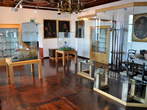
The Skofja Loka Museum is located in Loka Castle in Skofja Loka, which was first mentioned in 1215. The Skofja Loka Museum is a general museum with historical, archaeological, ethnological, cultural-historical, art and natural history collections. It was founded in 1939 and covers the area which for 830 years (973-1803) formed the Loka Estate under the authority of the Freising Bishops of Bavaria. The museum is located in the first flour, in the ground floor and in basement spaces. In the ground floor we can see Loka Estate, castles, the town, guilds, compatriots and education, furniture from Visoko, Loka's painted bourgeois pottery, Medieval art, altars from Drazgose, gallery and round tower. In the first floor we can see art gallery, black kitchen, lamps, architecture, agriculture, animal husbandry, food, transport, sieve-making, lace-making, linen-making and dyeing, small bread, artificial flowers, recent history collection, natural history collection and archaeological collection. In the basement spaces are Copies of Gothic frescoes and Gallery of Skofja Loka visual artists of the 20th century.
Other
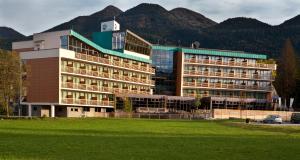
Bohinjska Bistrica belongs to the Bohinj Municipality. It is the largest village in the Bohinj valley and the seat of the community. It is an important tourist place. Bohinjska Bistrica is situated between hills Ajdovski gradec and Dobrava and between brooks Bistrica and Belica. The village divides road from the railway station to the Lower and Upper village. Bohinjska Bistrica is a starting point for mountaineering trips to Vogel, Ratitovec, Crna prst, Komna and other. Over Upper Sorica and Sorica mountain pasture is connected with Selska valley. The road was made after the Second World War. In the village is very well known ski center Kobla. There are 3 double chair lifts and 3 drag lifts on Kobla. Here is located the Bohinj railway tunnel, which connects Gorenjska Region with Primorska Region. In Bohinjska Bistrica are railway tunnel, sports hall, open playground for tennis, football playground, elementary school, bus station, museum, restaurants, shops, private hotels, hotel, health service, local office, tourist informative centre, fire station, monument in memory of Second World War, Zois Manor with Tower Clock, First World War Military Cemetery, the Church of Saint Nicholas and other. The Aquapark Bohinj offers spoiling in the saunas, swimming pools, wellness and fitness. They have varied offer of food. In special offer they have romantic coddling for two. Next to the Aquapark Bohinj is located interesting and beautifully arranged Ceconi’s Park.
The Museum of Alpine Dairy Farming is situated in Stara Fuzina, which is a typical alpine village with preserved old farm houses. The museum was opened in 1971 and reorganized in the year 1990. The museum is arranged in the abandoned village cheese dairy, which was built in 1883 and where were producing cheese until 1967. The museum of dairy farming and cheese making is shown in four rooms.
In the first room we can see the alpine dairy hut with furnishing from the alpine pasture Zajamniki and originates from the year 1849.
In the second room we can see the original cheese dairy with large built in rennet vats and a press for forming cheese loaves. There are exhibited the original things of the interior furnishings of cheese dairies as are milk bowls, butter churns, cheese making utensils and other. In the show case we can see a large backpack with the equipment of alpine dairymen and herdsmen they took up to the monuntain pastures.
At the entrance to museum are shown a print with house signs used by farmers to identify their crockery and equipment, a cartographic presentation of the most ancient references to alpine pastures and a portrait painting of the parish priest Janez Mesar. Janez Mesar stimulated the cultural and economic revival of Bohinj.
In the third room we can see photographs which show settlements and alpine dairy huts at Bohinj.
In the fourth room we can see the oldest depiction of the Triglav, an alpine herdsman of Bohinj and the alpine pasture of Velo polje. There are shown portraits of old dairymen and herdsmen, their working day, leisure, food and other. We can also see a traditional tourist event named Cow Ball of Bohinj.
 KRAJI - Slovenia
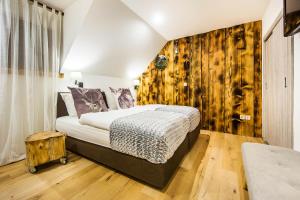 BrezovicaHotel Pok Garni