Source: Public information of Slovenia,
The Surveying and Mapping Authority of the Republic of Slovenia,
State map in measure 1 : 1.000.000, 1995
www.gu.gov.si
Recommended
Other
Bled belongs between the most beautiful places in Slovenia. Through all the year round is visited by many local and foreign tourists, because it is wonderful in every time of the year. The Spa Park is located in the immediate nearness of the Hotel Jelovica Bled. The Spa Park was created around 1891 when Spa Home was built. Gardeners Matevz and Joza Cop, who designed it, were influenced by Swedish landscaper Swenson who designed the park around Vila Pongratz (now Community of Bled). Besides Spa Home, which was a kind of cultural centre of Bled, there was also a music pavilion in the Park, tennis courts and stalls with sweets. Due to its programme and culture variety the Park was very popular and visited, and in the music pavilion there was live music every day. Today they have in the park in the summer time stalls, where they sell home made products. In the Spa Park you can see the memorial plate for Arnold Rikli, which was raised at the 125th anniversary of Institute of Natural Healing in Bled. Arnold Rikli was a beginner of the spa tourism in Bled. His methods, united with the contemporary therapy are today continued in the Hotel Golf. In Spa Park they organize in August the Okarina the Okarina Folk Festival Bled. There you can see performances of Slovene and foreign ethno musicians of world renown.
Bohinjska Bistrica is the largest village in the Bohinj valley and seat of the community. It is situated between hills Ajdovski gradec and Dobrava and between brooks Bistrica and Belica. In Bohinjska Bistrica are railway tunnel, sports hall, open playground for tennis, football playground, elementary school, bus station, museum, restaurants, shops, private hotels, hotel, health service, local office, tourist informative centre, fire station, monument in memory of Second World War, Zois Manor with Tower Clock, First World War Military Cemetery, the Church of Saint Nicholas, ski center Kobla and other. Next to the Aquapark Bohinj is located interesting and beautifully arranged Ceconi’s Park. Ceconi’s Park got the name by the Giacomo Ceconi, who was born in the north east Italy. He was the mason’s worker and successful entrepreneur. He contributed a great deal to the development of his birthplace Pielungo. Austria-Hungary and the Kingdom of Italy bestowed a noble title on him in recognition of his great service. His company took on the building of the Bohinj Tunnel, his last great work, in May 1902 and completed it in March 1905. From Bohinj, Count Ceconi set off for Pielungo, where he had a castle. Even after retirement he continued to work for the development of his birthplace. The present day park is the only surviving remnant of the building complex built by the Ceconi company and the state to accommodate the contractor and his family, company officials and state inspectors. The buildings were demolished in the 1980s. The project of the Ceconi’s Park is the work of Mimi Zvab. We can walk between the small gardens and enjoy in views to the wonderful flowers. The park is also intended for wedding ceremonies and cultural activities. It lies by the western bank of the brook Belca.
Kranjska Gora is a well-known sports and tourist center that attracts many local and foreign visitors throughout the year. The story of the place goes back to the second half of the 14th century, when the inhabitants began to clear forests and turn them into pastures for cattle and sheep and agricultural centers.
It became strategically important during First World War, when Russian prisoners made a military road across the Vrsic Pass from the Sava Valley to the Soca River Valley. As a tourist destination, Kranjska Gora became famous with the construction of the railway line and the first visitors. In the later times, however, the summers and the jumps in Planica brought the name of the valley and place to the world. This contributed to the rapid tourist development of the area, especially when the first ski lifts were erected on the slopes of Vitranc in the late 1950s. The sculpture park is located in the center of Kranjska Gora, in the area behind the Grand Hotel Prisank. In 2004, a sculpture colony was held in Kranjska Gora, which supported it financially Hotel and tourism company Gorenjka. In the area of the park there was once a wild, unguarded parking lot, which with the new arrangement enriched the tourist offer of the place in the cultural and artistic field. The sculptures are the work of artists Boni Ceh, Francisek Berce, Crtomir Frelih, Metod Frlic and Boget Dimovski.
They are made of stone and wood. The entire landscape architectural arrangement of the park offers the walker is a combination of sculptural and park elements that are designed to fit into the wider Alpine landscape of Kranjska Gora.
Preseren grove was in 1952 reorganized by plans of architect Marjan Sorli from previously abandoned city Kranj cemetery. Grove is in the property of community Kranj. Renovation was going under the expertise of Institute for protection cultural heritage. The area is designed as grove because of historical part and piety. It is a place for rest, meditation and cultural inspiration. Paving stone footpaths are from all sides concluded in the central part with transitional booth on eight columns with three time divided semicircular roof. At the end of 18. century they left off the cemetery at church Saint Kancijan and started to bury in the small place of today's Preseren grove. The cemetery expanded at the end of 19. century, but in 1939 was gave up because of space distress. On this place they preserved only some of the most important historical tombstone and cultural monuments, which are the tombstone of France Prešeren, Simon Jenko, Janez Puhart, the famous inventor of photography on glass, mausoleum Majdic, bust statue France Prešeren and grave of Presern's daughter Ernestina Jelovšek.
 KRAJI - Slovenia
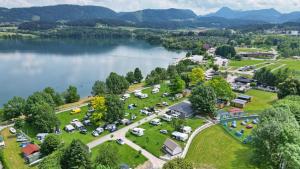 VelenjeCamp Velenje